
ELV quantity take-off: the complete guide for GCC pre-sales engineers
An ELV take-off is not one count. It is six kinds of reasoning across CCTV, access control, cabling, fire alarm, PA and intercom, checked before any number is priced. This is the whole process, written for the engineer who has to defend it.
- Doc no
- TQ-BLG-261014-TO
- Rev
- Issued
- Author
- Zakaria Syed
- Category
- Take-off
- Reading
- 10 min
An ELV quantity take-off is the count and measurement of every extra low voltage device, assembly and cable run on a set of tender drawings, recorded per floor and per system so it can be turned into a bill of quantities. Done properly it is not one count: cameras are counted by type, doors are assembled from their hardware, data outlets are aggregated into panels and switches, speakers are distributed into zones, and cable is measured. Each quantity should carry the sheet it came from, be checked by a second method, and be approved before it is priced. This guide covers the whole process for GCC tenders.
What an ELV take-off covers
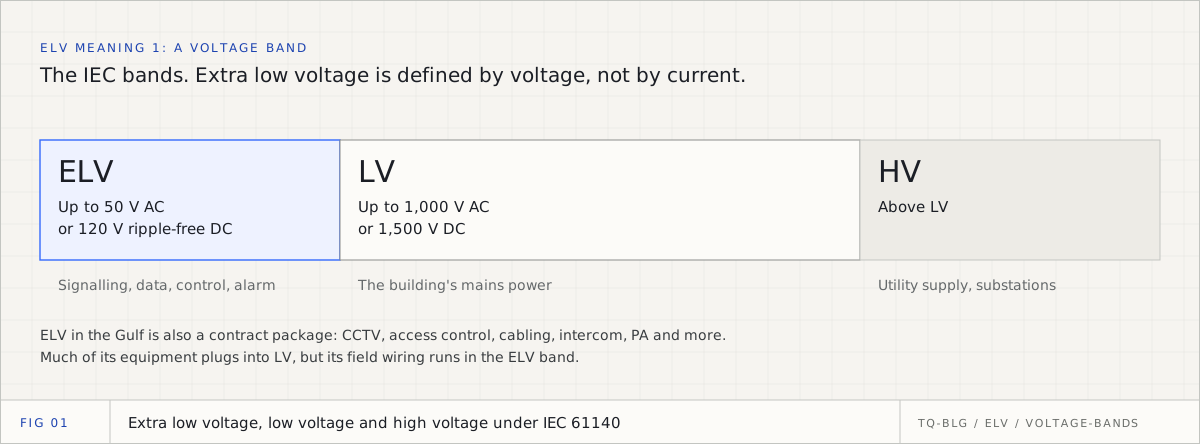
ELV (also called low current in the Gulf) is the bundle of systems that run below mains voltage: security, communications, audio and life-safety signalling. Read twenty pre-sales job descriptions in Dubai and Riyadh and the same scope appears every time: structured cabling (SCS), CCTV, access control (ACS), intruder detection, public address and voice alarm, intercom, IPTV and SMATV, gate barriers and car park systems, and interfaces to the building management system. Fire alarm sits in the ELV package on some projects and with the MEP contractor on others. New to the term? What ELV systems are, and who approves them explains each one.
The take-off is the first engineering step in pricing any of it. It answers three questions for every system, on every floor:
- What is on the drawing, and how many of each type?
- What does each of those items imply that is not drawn (power supplies, controllers, switch ports, storage, cable)?
- How sure are we, and who checked?
The third question is the one most take-offs skip, and it is the one a tender review asks first.
Before you count: build the drawing register
Most take-off errors are decided before the first symbol is counted. Spend the first half hour on the register:
| Field | Where it comes from | Why it matters |
|---|---|---|
| Drawing number and revision | Title block | Counting Rev C while Rev D is issued is the most expensive error in tendering |
| Level or floor | Title block text, not the sheet number | Sheet numbering conventions vary by consultant; the stated level does not |
| Scale | The stated ratio, for example 1:200 at A1 | Needed for any length; never guess it from paper size |
| Discipline and system | Drawing number convention and title | Decides which categories you expect to find |
| Legend | Legend sheet or legend panel | Defines the categories; rarely holds usable quantities |
| Typical floor note | Title block or general notes | Tells you which floors repeat |
Two rules here save most of the rework later. First, a sheet with no stated scale gets no length taken off it until the scale is confirmed. Second, if a floor plan and a riser schematic disagree on which floors exist, stop and resolve it before counting, because every downstream total depends on it.
The counting rules, system by system
ELV systems differ less in their symbols than in the kind of reasoning that turns a symbol into a number. This is the table we work from:
| System | Reasoning | What you actually count | What you derive |
|---|---|---|---|
| CCTV | Count, by type | Cameras by type, class and mounting (dome, bullet, PTZ, external, lift) | Recorder channels, storage, PoE switch ports and power budget, poles and brackets |
| Access control | Assemble | Controlled doors, and the hardware at each | Controllers, lock power supplies, cable per device |
| Structured cabling | Aggregate | Outlets and data points per floor | Horizontal cable, patch panels, switch ports, cabinets, backbone |
| Public address and background music | Distribute | Speakers per zone, by type | Zone count, amplifier wattage, line cable |
| Intercom | Distribute | Door stations, indoor stations, guard stations | Distributors and riser cable |
| Fire alarm | Count, then loop | Detectors, call points, sounders, modules | Loops, isolators, panels, cable |
| Disabled toilet alarm | Derive | Accessible WCs on the architectural plan | One kit per WC |
| Gate barriers | Measure | Lanes and widths | Boom length per lane |
CCTV
Count cameras by type, never as one number. A fixed dome, an external bullet, a lift camera and a PTZ carry different prices, different mounting and sometimes a different recorder licence. Where the consultant uses performance classes (detection, observation, recognition, identification), keep them as separate lines, because the class drives the lens and resolution. In Dubai, the SIRA technical specification sets the floor: cameras of at least Full HD 1080p, outdoor cameras at least IP66, and recording for not less than 31 days with recorders computed with 20 percent extra capacity. Those three numbers feed straight into the recorder and storage lines, so record them as assumptions in the take-off. The CCTV take-off guide covers counting cameras by type and tag, and the CCTV BOQ guide works the storage, PoE and UPS arithmetic through in full.
Access control
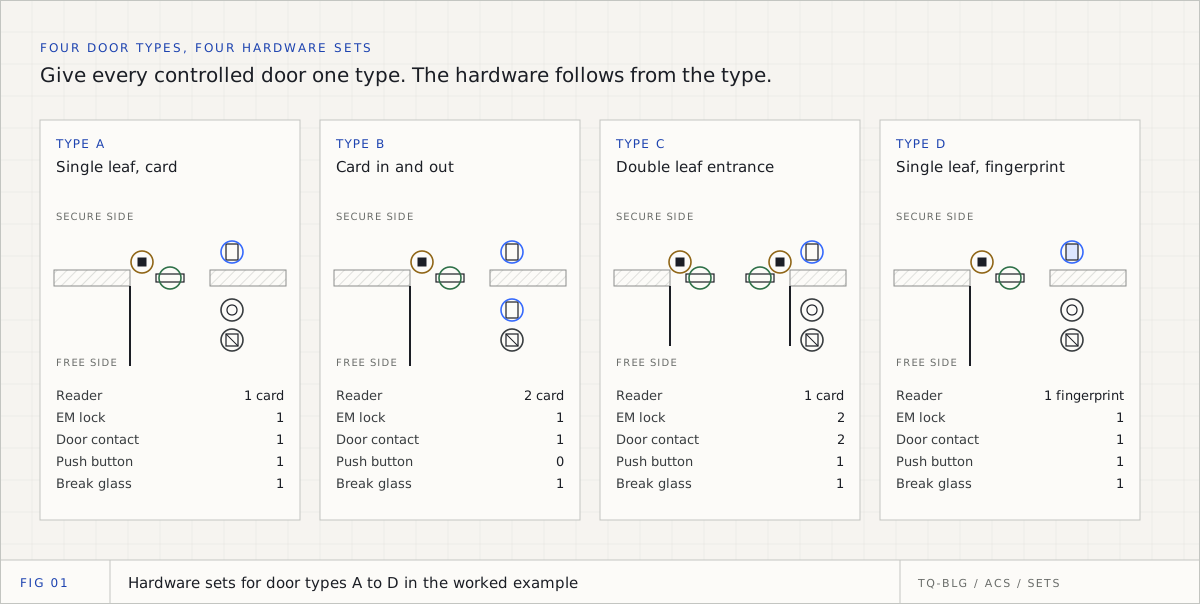
Nobody should count card readers. Count doors, and assemble each one. A typical controlled single-leaf door is a reader, an electromagnetic lock, a door contact, an exit push button and a break glass unit, plus its share of a controller and a lock power supply. A door with a face reader, an exit reader or a double leaf changes the assembly. Build a door-type schedule, count doors by type per floor, and let the hardware quantities fall out of it. The SIRA specification adds requirements that change the bill: locks must release automatically in an emergency, the system must integrate with the Civil Defence approved fire alarm, and the control panel battery must last at least four hours. The access control take-off guide works a door-type schedule through to controllers.
Structured cabling
Count data points, not faceplates: a double outlet is two cables. Then aggregate upward. Points become horizontal cables, cables terminate on patch panels, panels feed switch ports with spare capacity, and floors connect to the main equipment room over a backbone. The only hard limit at take-off stage is length: a permanent link is limited to 90 m, within a 100 m channel that allows a combined 10 m of cords. In Dubai, in-building telecom provisions follow the TDRA Buildings Telecommunications Network Specification Manual, which the Dubai Development Authority made mandatory in its version 3 from May 2024. How to turn points into metres of cable is a subject of its own, covered in the ELV cable calculation guide; sizing the switches, panels and racks those points need is in how many PoE switches for CCTV.
Fire alarm
Where fire alarm is in your package, count detectors by type (smoke, heat, multi-sensor, beam), manual call points, sounders and beacons, and interface modules separately. Then think in loops. The UAE Fire and Life Safety Code requires addressable systems in new buildings, Class A wiring, loop isolators, and wiring that is 2-hour fire rated and Civil Defence listed. Loop capacity is set by the panel: one common addressable panel data sheet allows up to 159 detectors and 159 modules per loop. Count the devices first, then size loops with the manufacturer's loop calculator, keeping a spare margin. The fire alarm take-off guide turns the code into BOQ lines.
Public address, background music and intercom
Count speakers by type (ceiling, wall, horn, pendant) per zone, because zones, not speakers, decide the amplifier channels. The tap setting on each speaker decides the amplifier wattage. Intercom is distributed the same way: door stations at entrances, indoor stations per unit, and the riser equipment that connects them. In both systems the riser schematic usually carries information the floor plan does not, so read them together.
Typical floors
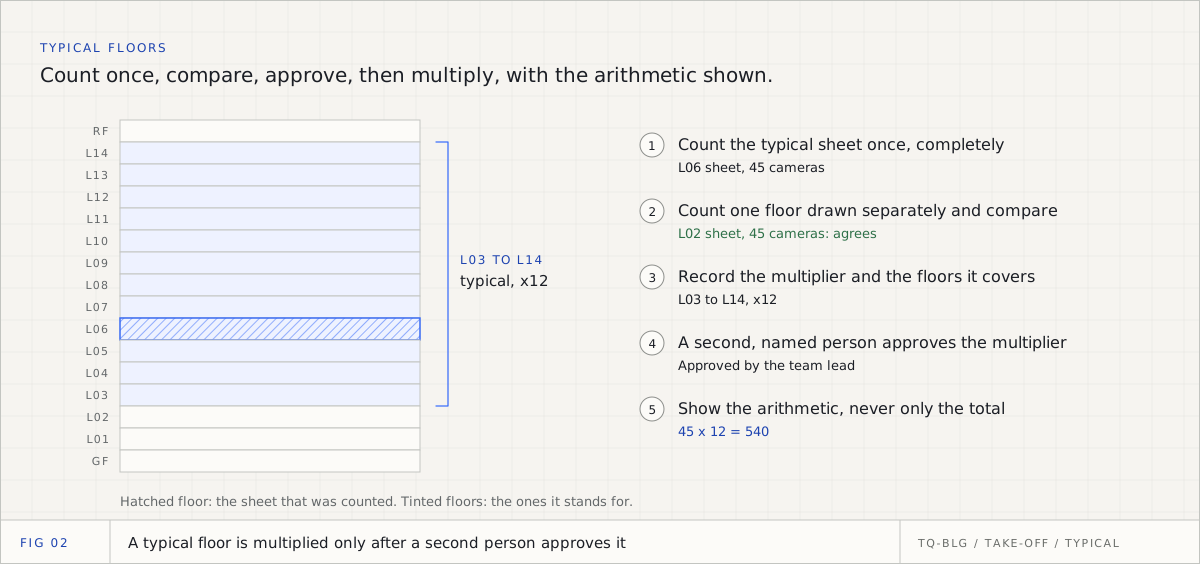
Dubai and Riyadh towers are typical-floor buildings, and the typical floor is where one counting error becomes twenty. The safe method:
- Count the typical floor sheet once, completely.
- Count one other floor that is drawn separately, if one exists, and compare. A typical floor that differs from its neighbours by a device or two is normal; one that differs by a category is a warning.
- Record the multiplier and the floor list it covers, for example "Levels 3 to 14, x12".
- Have a second person approve the multiplier before it is applied.
- Show the arithmetic in the take-off, never just the total: 45 cameras x 12 floors = 540 is checkable; 540 is not.
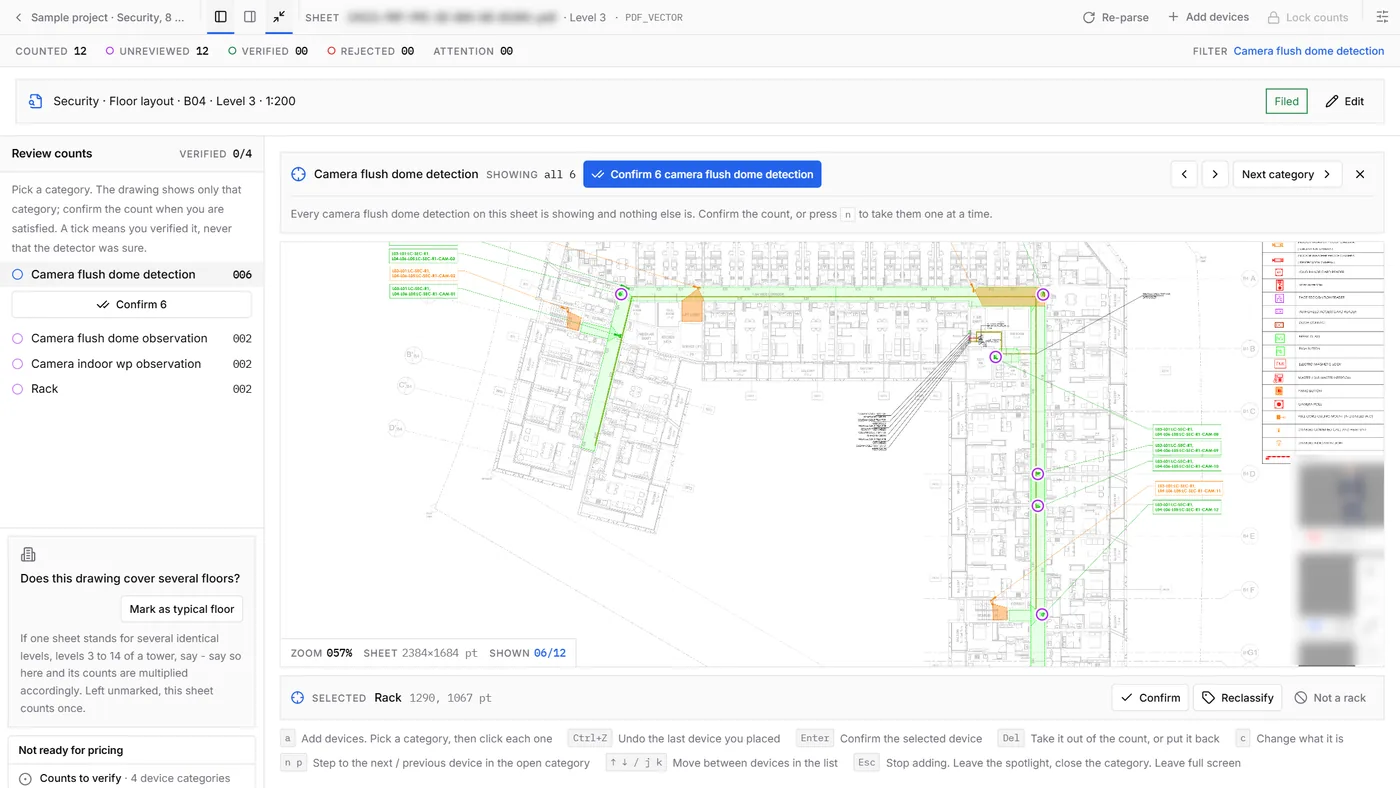
In TrueQty a sheet can be marked as a typical floor, but the multiplier only applies after a named person approves it, and the matrix shows it as arithmetic. The sheet's floor is read from its title block only; a sheet whose floor nobody stated is held at one until a person confirms it (why the title block decides). That order matters more than the software: the person who counted should not be the only person who decided to multiply.
The errors that cost the most
| Error | How it shows up | The check that catches it |
|---|---|---|
| Counting a superseded revision | Totals that do not match the client's later queries | Register every sheet with its revision before counting |
| A typical floor that is not typical | One floor's count is the same as twelve others, but the plan differs | Compare against one separately drawn floor |
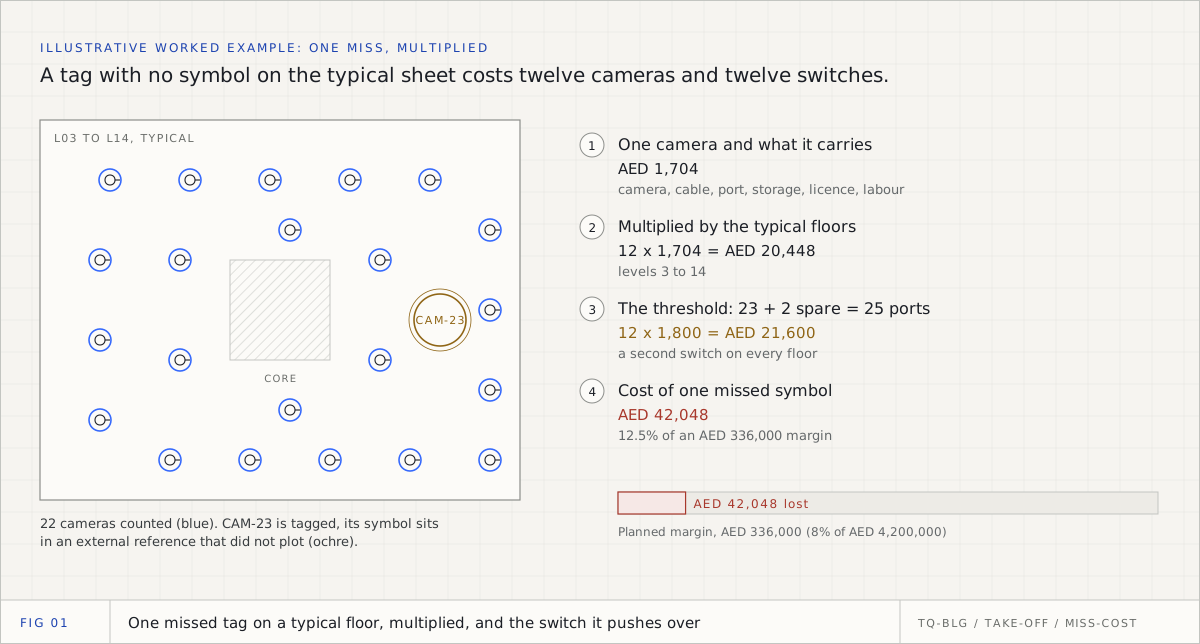
| Devices drawn in an external reference | A device tag on the sheet with no counted symbol nearby | Reconcile tags against symbols |
| Legend quantities used as the count | Total equals the legend schedule exactly, on every floor | Count from plans, use the legend as a cross-check only |
| Ambiguous abbreviations | "SD" counted as smoke detector on an ELV sheet, or as single data on a fire sheet | Confirm every abbreviation against the legend and the discipline |
| A silent zero | A floor shows zero of a category every other floor has | Flag any zero where peer floors have two or more |
| Riser and plans disagree | Plan shows 72 network devices, riser serves 64 ports | Reconcile plan counts against the riser schematic |
Drawings that make counting hard in the first place (flattened exports, sheets with no legend, scanned plots) have their own failure modes, covered in take-off from difficult drawings.
Verification: six checks before anything is priced
A take-off is verified when someone other than the counter can see where each number came from and agrees with it. These are the checks we run:
- Trace. Every quantity points to a sheet and a location on it. If you cannot click, or at least point, from the number to the mark, the number is unverified.
- Second method. Count tags as well as symbols, or doors as well as readers. Two methods that agree are evidence; one method twice is not.
- Peer floors. Compare each floor with the median of similar floors. Zeros and anything above three times the median get a second look.
- Riser reconciliation. Network devices on the plans against switch ports on the riser; intercom stations against distributor capacity.
- Category coverage. Every category in the legend either has a count or a recorded reason it has none on this floor.
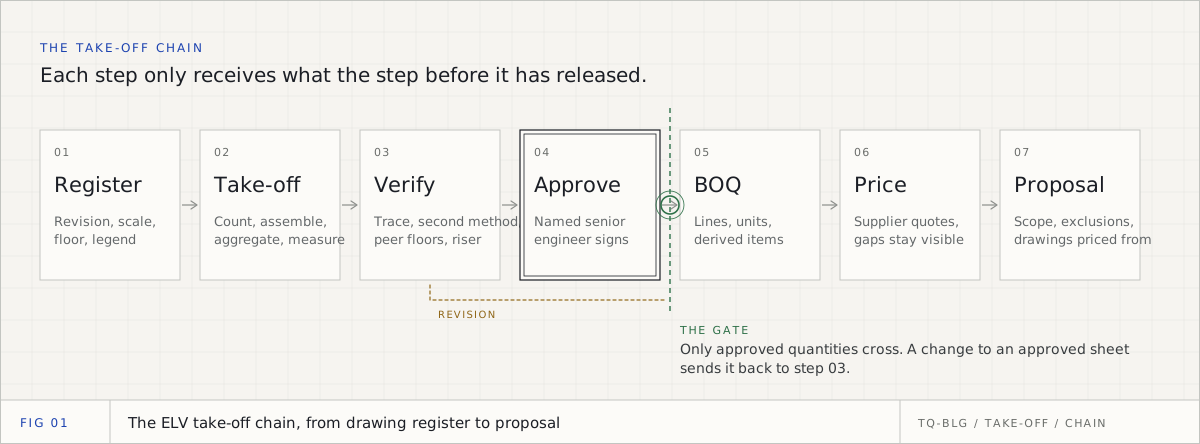
- Named sign-off. A senior engineer approves the take-off, by name, before it moves to pricing. Changes after approval reopen it.
TrueQty is built around this step: every detection carries its evidence (file, page, layer, tag), review happens by category rather than device by device, and flags such as a tag with no counted symbol ask a person to look without changing the count. On one contractor's real ground-floor access control BOQ, the counts matched on door contacts (15 of 15), EM locks (13 of 13), push buttons (11 of 11) and face readers (3 of 3). The two devices it missed on that floor were drawn in an external reference, and both were raised as flags for a person to resolve. That is the point of verification: not a perfect count, but no silent miss.
From take-off to BOQ, priced bill and proposal
Once the take-off is approved, the rest of the chain is arithmetic and judgement:
- BOQ. Turn quantities into described line items with units, and add the derived items (controllers, patch panels, switches, storage, cable, containment). The worked ELV BOQ example builds one across CCTV, access control and structured cabling.
- Pricing. Match each line to supplier quotations. Keep unmatched lines visible as gaps rather than pricing them at zero.
- Proposal. Scope, exclusions, assumptions, the priced summary by system, and the drawings and revisions it was priced from.
The discipline that holds the chain together is simple: only approved quantities reach the BOQ, and a change to an approved sheet sends it back for approval. In TrueQty a team lead sends each sheet for pricing, the server enforces that gate so it cannot be skipped from the interface, and reading a sheet again withdraws it from pricing while keeping the review decisions already made. See how the product handles each step.
Where software helps, and where it should not decide
Software is good at the repetitive part: reading symbols, tags and layers from a vector drawing, keeping the per-floor matrix, doing the derived arithmetic the same way every time, and never forgetting a floor. It is bad at the part that carries liability: deciding that a count is right. Choose a tool that shows you why it counted what it counted and lets a named person approve it. A tool that only gives you a total is asking for trust it has not earned (the case is made in full in why every quantity should be traceable). What each step of the chain can safely hand to software is set out in ELV take-off automation. The 2026 comparison of take-off software for ELV contractors applies those criteria to the real options, including spreadsheets.
A last note on measurement conventions. Many GCC contracts still name POMI, the RICS Principles of Measurement (International), even though RICS archived it in March 2023; others name NRM 2 or a client's own method. For ELV this mostly decides how items are described and whether cable is measured net or with allowances, so read the preambles before you finalise units. Then price, and keep the take-off with the tender file: the day a variation claim turns on how something was counted, it is the only document that answers.
For per-system detail beyond this guide, see how TrueQty reasons about each ELV system, and pricing if you want to try the process on your own drawings.
Take off one real ELV sheet, with the evidence for every count on the drawing.
14 days, one full ELV tender, no card. Sign up with your work or personal email. You check every count, a team lead approves each sheet, and only approved sheets reach the BOQ.
Questions engineers ask
- Q01What is included in an ELV take-off?
- Every device, assembly and length the extra low voltage systems on the drawings need, counted or measured per floor and per system. In GCC tenders that usually means CCTV, access control, structured cabling, intercom, public address and background music, fire alarm where it is in the ELV package, and specials such as gate barriers, SMATV or IPTV, and disabled toilet alarms. The take-off records each quantity with the sheet and floor it came from.
- Q02What is the difference between a take-off and a BOQ?
- A take-off is the set of quantities read from the drawings, floor by floor. A bill of quantities is the priced document built from it, with item descriptions, units, derived items such as patch panels, switches and cable, and rates. The BOQ is only as good as the take-off underneath it, which is why the take-off is verified first.
- Q03Do I count from the legend or from the plan?
- From the plan. The legend tells you what a symbol means; it rarely carries quantities, and when it does they are often building-wide or out of date. Use the legend to build your category list, count on the plan sheets, and treat any legend quantity as a cross-check, not a source.
- Q04How do I handle typical floors without multiplying an error?
- Count the typical floor once, check it against at least one other floor drawn separately, record the multiplier and the floors it covers, and have a second person approve the multiplier before it is applied. Show the arithmetic in the take-off (for example 45 x 12) so anyone can see where the total came from.
- Q05Which measurement standard applies to ELV BOQs in the GCC?
- The contract decides. Many GCC contracts still name POMI, the RICS Principles of Measurement (International), even though RICS archived it in March 2023; others use NRM 2 or a client's own method of measurement. ELV items are usually measured as numbered items (each) for devices and linear metres for cable and containment.
Sources
Every external fact in this document is cited to one of these, fetched when it was written.
- [01]SIRA, Standard and Technical Specifications of the Security Systems, Version 4.0 (2022)sira.gov.ae
- [02]Dubai Civil Defence, UAE Fire and Life Safety Code of Practicedcd.gov.ae
- [03]Dubai Development Authority, Circular 595 on the TDRA Buildings Telecommunications Network Specification Manual v3dda.gov.ae
- [04]Fluke Networks, Say Goodbye to the Weakest Links (permanent link and channel lengths)flukenetworks.com
- [05]Notifier NFS2-640 data sheet DN-7111 (devices per SLC)honeywellbuildings.in
- [06]RICS, New Rules of Measurement (NRM)rics.org
- [07]RICS isurv, Principles of Measurement (International) for Works of Constructionisurv.com

Zakaria is a mechanical engineer and the co-founder and COO of AI Agentiva in Dubai. He builds TrueQty, and writes here about how ELV quantities are counted, checked and priced, and where take-offs go wrong.
Related documents
Access control take-off: doors, hardware sets and controllers from tender drawings
In access control the unit is the door, not the device. This is how to build hardware sets per door type, read the door schedule against the plans, count doors by type, derive controllers and power supplies, and check the result before it reaches the BOQ, with a worked 32-door example.
The hidden cost of manual ELV take-off: where devices get missed and what one miss costs
A manual ELV take-off rarely fails in a way anyone notices on the day. It fails when one missed symbol on a typical floor is multiplied twelve times and pushes a switch over its ports. This is where the misses hide, an illustrative AED example of what one costs, and the checks that catch them before the tender goes.
What are ELV systems? The meaning in construction, the full list, and who approves them
ELV means two things. To an electrical engineer it is a voltage band under 50 V AC. To a Gulf contractor it is a package of systems: CCTV, access control, cabling, intercom, PA and more. This explainer covers both, the list, and who designs, approves and prices them.