
What are ELV systems? The meaning in construction, the full list, and who approves them
ELV means two things. To an electrical engineer it is a voltage band under 50 V AC. To a Gulf contractor it is a package of systems: CCTV, access control, cabling, intercom, PA and more. This explainer covers both, the list, and who designs, approves and prices them.
- Doc no
- TQ-BLG-261022-9G
- Rev
- Issued
- Author
- Zakaria Syed
- Category
- Take-off
- Reading
- 10 min
What are ELV systems? ELV systems are the building systems that run on extra low voltage, below mains power: CCTV, access control, structured cabling, intercom, public address, intrusion alarm, fire alarm signalling and similar systems for security, communication and control. The term has two meanings that are worth keeping apart: a voltage band defined by the IEC (up to 50 V AC or 120 V ripple-free DC), and, in UAE, Saudi and Qatari construction, a contract package of those systems that a specialist contractor designs, prices and installs.
If you work in a Gulf contractor, a consultant's office or a developer, ELV (or "low current") is a line in every tender: a set of drawings from the consultant, a section of the BOQ priced in AED or SAR, and a subcontractor who has to get it approved. This guide explains the term for newcomers and juniors, lists the systems, and shows who touches them from design to handover. Once you know what the systems are, the ELV quantity take-off guide shows how each one is counted.
ELV meaning 1: a voltage band
In electrical standards, voltage is split into bands, because the risk of electric shock, and so the protection a circuit needs, depends on the voltage. The current basic safety standard, IEC 61140:2016, puts the extra-low-voltage band at up to 50 V AC or 120 V ripple-free DC. Above it is low voltage (LV), which IEC 61140 takes up to 1,000 V AC or 1,500 V DC, the band a building's mains supply sits in. Above that is high voltage.
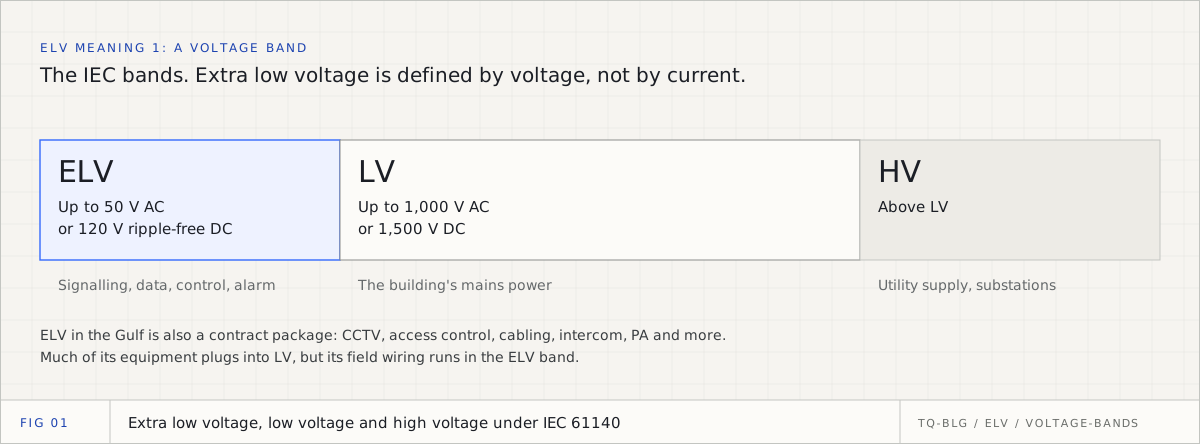
The older IEC 60449, now withdrawn, made the link to building systems explicit. Its Band I covered installations where protection against shock comes from the low voltage itself, and installations where the voltage is limited for operational reasons, and named them: telecommunications, signalling, bell, control and alarm installations. That list is, almost word for word, the ELV package on a modern tender.
Two points confuse juniors here:
- ELV equipment is often fed from LV. A network video recorder, a PoE switch or a PA amplifier plugs into a 230 V socket. The system is still called ELV because its field wiring (to cameras, readers, speakers, detectors) runs at extra low voltage, and because the package is defined by function, not by the plug.
- "Low voltage" means different things in different markets. In North American usage "low voltage" often means what the Gulf calls ELV, while under IEC it means the mains band. Read "LV" on a GCC drawing as mains power.
ELV meaning 2: a package of systems
On a Gulf project, ELV is a scope of work. The consultant's MEP or security engineer draws a set of ELV drawings, the tender carries an ELV section in the BOQ, and an ELV contractor (often a subcontractor to the MEP contractor) supplies, installs, tests and commissions it. Job adverts say "ELV engineer", "ELV estimator" or "low current engineer", and they mean the same work. "Low current" is the trade name, common across the UAE, Saudi Arabia and Qatar; ELV is the name the standards use.
The package is defined by the contract, not by physics. Fire alarm is technically ELV but often sits with the MEP or fire-fighting contractor. Building management systems are partly ELV (sensors and controllers) and partly mechanical. So the first question on every tender is not "what is ELV?" but "what does this scope of works put in the ELV package?"
The ELV systems list
These are the systems you will meet in GCC tenders, grouped the way consultants usually draw them:
| Group | System | What it does | Typical devices you count |
|---|---|---|---|
| Communications | Structured cabling (SCS) | The copper and fibre every networked device uses | Data outlets, patch panels, cabinets, backbone fibre |
| Communications | Active network (LAN, Wi-Fi) | Switches and access points on that cabling | Switches, wireless access points |
| Communications | Telephony (IP-PBX) | Voice | IP phones, gateways |
| Communications | IPTV, SMATV | Television distribution | TV outlets, headend, amplifiers |
| Security | CCTV (video surveillance) | Records and monitors cameras | Cameras by type, recorders, storage, monitors |
| Security | Access control | Controls who opens which door | Readers, locks, door contacts, exit buttons, controllers |
| Security | Intrusion alarm | Detects break-ins | Motion detectors, contacts, panels, sirens |
| Security | Intercom, video intercom | Visitors call a unit or a guard | Door stations, indoor stations, guard stations |
| Security | Gate barriers, car park | Vehicle access | Barriers, ANPR cameras, ticketing |
| Audio and life safety | Public address, background music | Announcements and music by zone | Speakers by type, amplifiers |
| Audio and life safety | Voice evacuation | Fire evacuation messages | Speakers, fire-rated cable, amplifiers |
| Audio and life safety | Fire alarm (where in scope) | Detects fire and raises the alarm | Detectors, call points, sounders, modules |
| Audio and life safety | Disabled toilet alarm, nurse call | Calls for help | Pull cords, indicators, call points |
| Building services | BMS integration | Connects systems to the building management system | Interfaces, gateways |
| Building services | Master clock, digital signage, AV | Time, information and meeting rooms | Clocks, screens, AV kits |
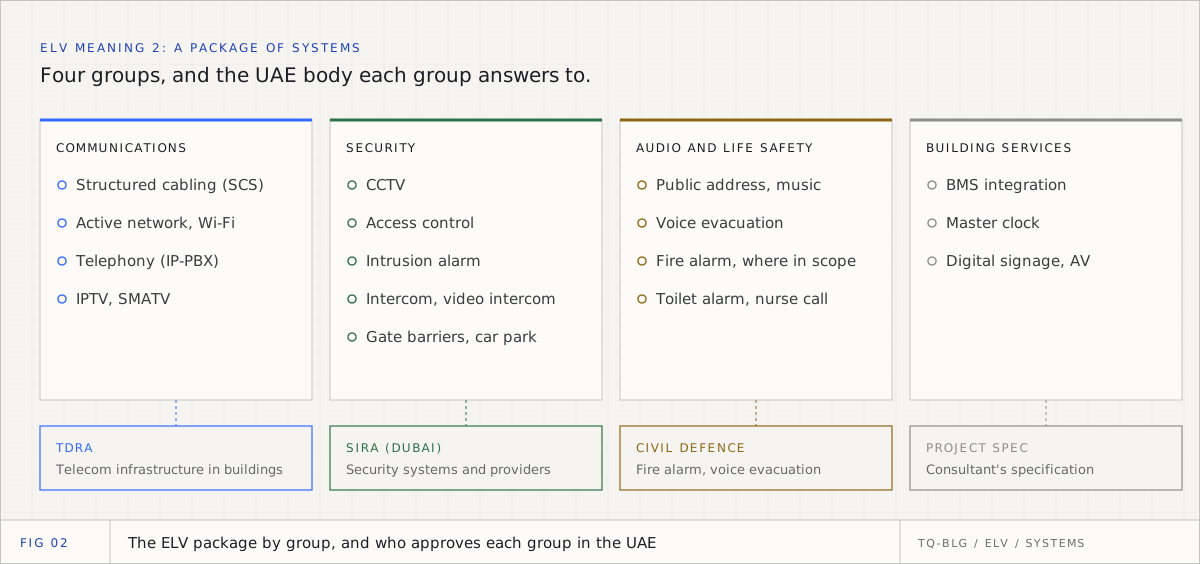
Not every project has all of them. An office tower might have SCS, CCTV, access control, intercom, PA and BMS integration; a hotel adds IPTV and guest room systems; a hospital adds nurse call. A villa compound might be CCTV, intercom and gate barriers only.
Who designs, approves and installs ELV systems
Five parties touch an ELV system before handover. Knowing who does what tells you where the requirements in a tender come from.
The consultant designs
The design consultant (an MEP firm, or a specialist security or ICT consultant on larger projects) produces the ELV drawings: floor plans per system with device symbols and tags, riser and schematic drawings, a legend, and a specification. Often there is a BOQ too, either fully measured or with quantities left for the contractor. The consultant's drawing conventions decide how hard the take-off is, which is why ELV drawing conventions: layers, legends and tags is worth reading before your first tender.
The regulators approve
Each group of systems answers to a different authority. In the UAE:
| Authority | What it covers | What it means for the ELV package |
|---|---|---|
| SIRA, Dubai (Security Industry Regulatory Agency) | Security systems: CCTV, access control, intrusion, barriers | Sets the technical specification, licenses security service providers and devices |
| Civil Defence | Fire and life safety: fire alarm, voice evacuation, the fire interface | Issues and enforces the UAE Fire and Life Safety Code |
| TDRA (Telecommunications and Digital Government Regulatory Authority) | Telecom infrastructure in buildings | Sets the Buildings Telecommunications Network Specification Manual |
SIRA. Dubai Law No. 12 of 2016 gives SIRA the job of setting and updating the specifications and standards for security, licensing security service providers and licensing the security devices its bylaw names. Its Standard and Technical Specifications of the Security Systems, version 4.0 of February 2022, is the document an ELV estimator in Dubai reads: it sets, among much else, camera resolution, recording days, UPS time and battery life. It also requires the building to keep a maintenance contract with a company registered at SIRA, with at least four preventive visits a year, and the technical maintenance staff to be registered too. The CCTV BOQ in Dubai turns those rules into BOQ lines. SIRA is a Dubai body; other emirates and countries have their own. In Saudi Arabia, the 2022 surveillance camera law requires prior approval from the Ministry of Interior before surveillance cameras are installed, operated or maintained.
Civil Defence. The UAE Fire and Life Safety Code of Practice, published by Civil Defence (Dubai Civil Defence carries the 2018 edition), governs fire alarm and voice evacuation. Where fire alarm sits in the ELV package, the code drives the BOQ: addressable systems, loop isolators and fire-rated cable, worked through in the fire alarm take-off for the UAE. Even where it does not, ELV touches it: SIRA's specification says the installation of security equipment must not cost a building the features approved by Civil Defence, such as fire-resistant doors, and access control locks must release on a fire alarm.
TDRA. TDRA's Buildings Telecommunications Network Specification Manual sets how new buildings provide telecom rooms, containment and cabling for the operators' networks. Version 3 took effect in 2024; the Dubai Development Authority's Circular 595 of 24 May 2024 told its customers to follow it immediately. It covers the infrastructure the telecom operators connect to, so check where the consultant draws the line between the TDRA scope and the owner's own SCS.
The contractor prices, installs and commissions
The ELV contractor, often a systems integrator, prices the package, buys the equipment from vendors and distributors, installs it, tests and commissions it, and hands over as-built drawings and manuals. In Dubai, the security part of that work needs a SIRA-licensed company. On many projects the ELV contractor is a subcontractor to the MEP contractor, so its price reaches the client inside the MEP tender.
The vendors quote
Vendors and distributors quote the equipment, often in US dollars or euros, and the contractor converts and marks up. Equipment choice is constrained by the specification's approved makes and, for security devices in Dubai, by SIRA approval.
The client operates
The building owner or facility manager runs the systems, keeps the maintenance contract, and, under SIRA's rules, tells SIRA about changes that affect the security systems.
How ELV systems are tendered and estimated
An ELV tender usually reaches the contractor as a folder: drawings per system and floor, risers, the specification, the BOQ format, and the tender conditions. The estimate is built in five steps:
- Register the drawings. Number, revision, floor, scale, system and legend for every sheet.
- Take off. Count every device by type, per floor and per system. Cameras are counted, doors are assembled from their hardware, data outlets are aggregated into panels and switches, speakers are distributed into zones.
- Derive. Add what the drawings imply but do not show: controllers, recorders, storage, switches, patch panels, cable, containment, UPS. The CCTV PoE switch calculation shows how far one camera count reaches into the bill.
- Price. Match each line to vendor quotations, converted to AED or SAR, and keep unpriced lines visible.
- Propose. Scope, assumptions, exclusions, the priced summary and the drawings it was priced from.
How long it takes depends on the drawings more than on the building. A clean vector drawing set with a legend and tags can be counted quickly; a scanned or flattened set with no legend takes far longer. Most of an estimator's time goes into the take-off and checking it, which is the work software helps with most.
What a junior gets wrong first
| Mistake | Why it happens | The fix |
|---|---|---|
| Counting a system that is not in scope | Fire alarm drawn in the ELV set, but tendered to the MEP contractor | Read the scope of works first |
| Treating ELV as one count | "86 devices" with no split by system or type | Count by system, by type, by floor |
| Missing the lines that are not drawn | BOQ copied from the symbols only | Derive controllers, switches, cable, storage |
| Pricing to the wrong rules | Dubai rules applied in Riyadh, or the reverse | Check the authority for the emirate or country |
| Counting card readers instead of doors | The reader is the visible symbol | Count doors, and assemble each one; see access control take-off |
How TrueQty fits in
TrueQty is take-off and estimating software for the ELV package. You upload the whole tender folder; every file is sorted, the drawings are read, and the documents are kept for context. It counts floor layouts, and PDF works best: a vector PDF is read using the CAD layer names kept inside it, tags and door-hardware clusters, and scanned PDFs are accepted. Risers and schematics are kept as reference. A DWG or DXF sheet cannot be shown for checking, so upload the PDF exported from CAD, the most accurate, or convert the sheet to PDF here and check every count against it. For flattened, scanned or no-legend sheets, you box one device and it finds the others like it, and a person names the set once. It proposes each sheet's system, drawing type, floor and scale for you to confirm.
You review one category at a time, with every device circled where it was drawn. A team lead sends each sheet for pricing, and only sheets sent for pricing reach the bill. The BOQ is generated from them, cable included, then priced against your own vendors' price lists, and the proposal comes out at sell price, in your brand. Public address speakers are read where the sheet's legend confirms them; fire alarm, background music and AV devices are counted by hand in the same review. Every count traces to a spot on the drawing, and a person approves it.
The TrueQty in 90 seconds guide shows the whole chain in one short video, and the product page covers each step.
Where to go next
If you are new to ELV, learn the systems from the list above, then learn to count them: the ELV quantity take-off guide goes system by system, from the drawing register to the approved count. If you will be pricing tenders in the Emirates, ELV estimation in the UAE covers the tender pack, AED pricing and vendor quotes in other currencies. And when a drawing set is the problem rather than the system, start with take-off from difficult drawings.
To price a package now, the free ELV BOQ template for Excel lays out CCTV, access control and data by floor, with the switch and cable box rules as formulas and the BOQ priced in AED. For cameras in depth, CCTV take-off for GCC tenders covers counting by type and floor, cable, switch ports and the BOQ.
Take off one real ELV sheet, with the evidence for every count on the drawing.
14 days, one full ELV tender, no card. Sign up with your work or personal email. You check every count, a team lead approves each sheet, and only approved sheets reach the BOQ.
Questions engineers ask
- Q01What does ELV stand for in construction?
- ELV stands for extra low voltage. In electrical standards it is a voltage band: under IEC 61140 it is up to 50 V AC or 120 V ripple-free DC. In Gulf construction it is also the name of a package of systems, such as CCTV, access control, structured cabling, intercom and public address, priced and installed by a specialist contractor.
- Q02What is the difference between ELV and LV?
- Low voltage (LV) is the band above ELV, up to 1,000 V AC or 1,500 V DC, which covers the building's mains power: distribution boards, lighting circuits and sockets. ELV is the band below it, used for signalling, data and control. On a GCC project, LV is usually the electrical contractor's scope and ELV is a separate package, even though many ELV devices are powered from an LV socket.
- Q03Is fire alarm an ELV system?
- Technically yes: a fire alarm panel runs its detection loops at extra low voltage. Contractually it depends on the project. Some GCC tenders put fire alarm in the ELV package, others give it to the MEP or fire-fighting contractor, because it is approved by Civil Defence under the fire code rather than by the security regulator. Read the scope of works before you count it.
- Q04What is the difference between ELV and low current?
- None in practice. Low current is the Gulf trade name for the same package, and job titles, tender sections and consultant drawings use the two words interchangeably. Technically it is the voltage, not the current, that defines the band, which is why the standards say ELV.
- Q05Who approves CCTV and access control in Dubai?
- SIRA, the Security Industry Regulatory Agency. Under Dubai Law No. 12 of 2016 it sets the specifications for security systems, licenses security service providers and licenses security devices. Its technical specification, version 4.0 of 2022, sets requirements such as camera resolution, recording days and the companies allowed to maintain the systems.
- Q06What does an ELV estimator do?
- An ELV estimator, often called a pre-sales engineer in the Gulf, reads the consultant's tender drawings and specification, takes off every device per system and floor, derives the items not drawn (controllers, switches, panels, cable, storage), prices them against vendor quotes, and writes the proposal with its assumptions and exclusions.
Sources
Every external fact in this document is cited to one of these, fetched when it was written.
- [01]BSI Knowledge, BS EN IEC 61347-2-2:2024 (ELV band of IEC 61140:2016: 50 V AC and 120 V DC)knowledge.bsigroup.com
- [02]IEC Webstore, IEC 61140 Protection against electric shock (low-voltage scope)webstore.iec.ch
- [03]EVS, IEC 60449:1973 Voltage bands for electrical installations of buildingsevs.ee
- [04]Dubai Law No. (12) of 2016 Regulating the Security Industry in the Emirate of Dubaidlp.dubai.gov.ae
- [05]SIRA, Standard and Technical Specifications of the Security Systems, Version 4.0 (2022)sira.gov.ae
- [06]Dubai Civil Defence, UAE Fire and Life Safety Code of Practicedcd.gov.ae
- [07]Dubai Development Authority, Circular 595 on the TDRA Buildings Telecommunications Network Specification Manual v3dda.gov.ae
- [08]Saudipedia, Law of the Use of Security Surveillance Cameras in Saudi Arabiasaudipedia.com

Zakaria is a mechanical engineer and the co-founder and COO of AI Agentiva in Dubai. He builds TrueQty, and writes here about how ELV quantities are counted, checked and priced, and where take-offs go wrong.
Related documents
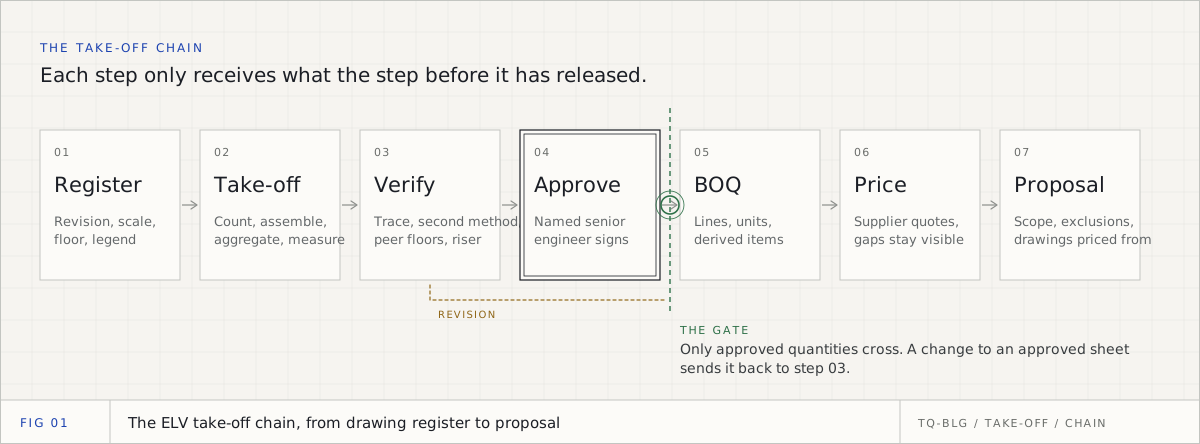
ELV quantity take-off: the complete guide for GCC pre-sales engineers
An ELV take-off is not one count. It is six kinds of reasoning across CCTV, access control, cabling, fire alarm, PA and intercom, checked before any number is priced. This is the whole process, written for the engineer who has to defend it.
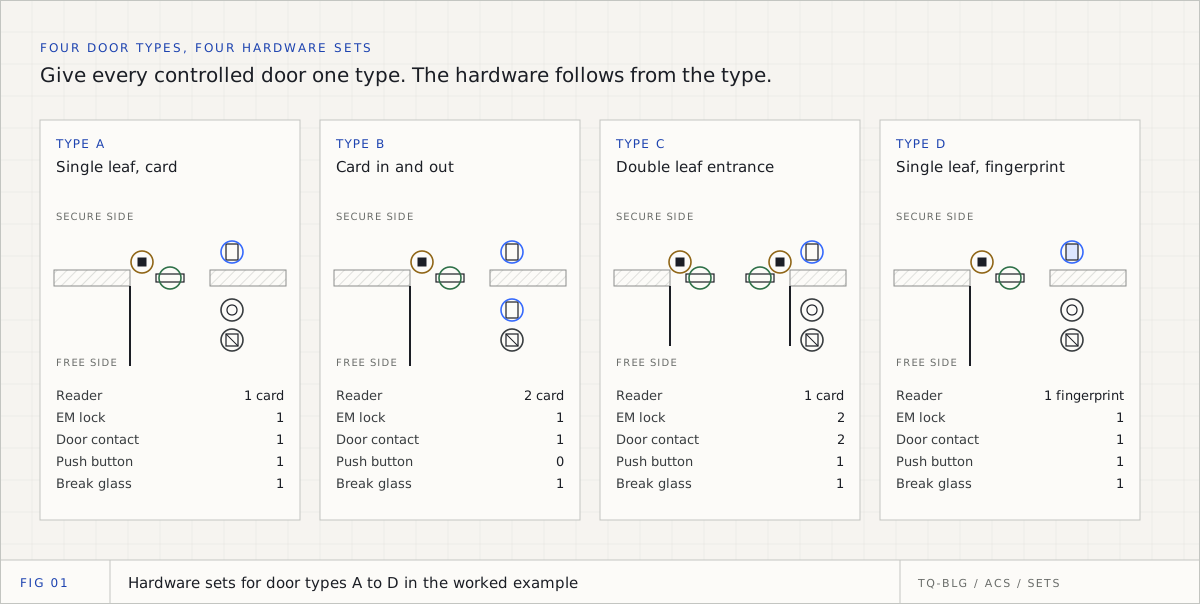
Access control take-off: doors, hardware sets and controllers from tender drawings
In access control the unit is the door, not the device. This is how to build hardware sets per door type, read the door schedule against the plans, count doors by type, derive controllers and power supplies, and check the result before it reaches the BOQ, with a worked 32-door example.
CCTV take-off from drawings: how to count cameras by type on a GCC tender set
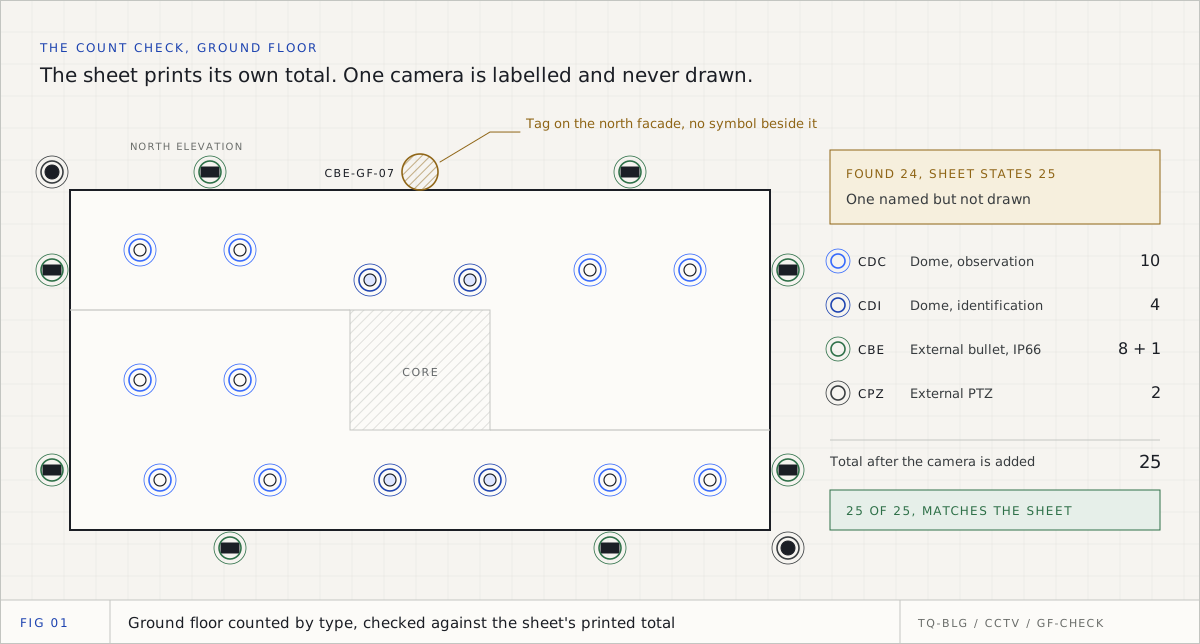
A CCTV take-off is not one number. It is a count of every camera by type, floor by floor, read from tags, layers and legends, checked against the totals the consultant prints and approved before it is priced. This is the method, with a worked 108-camera example.