
ELV estimation in the UAE: how ELV tenders are priced, from the tender pack to an AED proposal
How an ELV tender is estimated in the UAE, step by step: what is in the consultant's tender pack, how the quantities are built, how USD and EUR vendor quotes become an AED price at a stated rate, VAT, quote validity, qualifications, software cost and where your drawings are stored.
- Doc no
- TQ-BLG-261022-ED
- Rev
- Issued
- Author
- Zakaria Syed
- Category
- BOQ and estimating
- Reading
- 10 min
ELV estimation in the UAE means turning a consultant's tender pack into an AED price for the extra-low-voltage systems: you take the quantities off the drawings, derive what they imply, price them from vendor quotes against the approved makes, and qualify the result. The two things that are particular to the UAE are the money and the rules: USD quotes convert at the fixed 3.6725 peg, euro quotes need a rate you choose and state, VAT is 5%, and the authorities (SIRA in Dubai for security, Civil Defence for fire, TDRA for telecom rooms) set minimums that must appear as priced lines.
This post covers the commercial side of a UAE tender. For how the quantities themselves are counted, start with the ELV quantity take-off guide.
What arrives in a UAE ELV tender pack
A main contractor or developer sends the pack, usually through a portal or a shared folder, and the consultant's documents make up most of it. Sort it before you count anything.
| Document | What it tells the estimator | What to check first |
|---|---|---|
| Invitation and instructions to tenderers | Deadline, tender validity, form of tender, how to submit, the query deadline | Validity period and whether rates include VAT |
| Drawings | Floor plans per system, risers, schematics, details | Revision, scale, legend, typical floor notes |
| Specification | Device performance, standards, testing, approved makes | Approved manufacturers per system, spare capacity clauses |
| Bill of quantities (if issued) | The consultant's measured lines and units | Whether quantities are firm or "contractor to verify" |
| Addenda and query replies | Changes during the tender | Every one is read into the estimate, by number |
| Authority references | SIRA (Dubai security), Civil Defence (fire), TDRA (telecom rooms) | Which minimums become priced lines |
Two of those decide how much risk you are carrying. If the consultant issued a BOQ with firm quantities, you price their lines and the quantity risk is theirs. If the BOQ says the contractor must verify the quantities, or there is no BOQ at all, the quantity risk is yours, and your take-off is the bid.
The estimate, step by step
- Register every drawing. Sheet number, revision, system, floor, scale. This is what you will quote in your qualifications as "priced from".
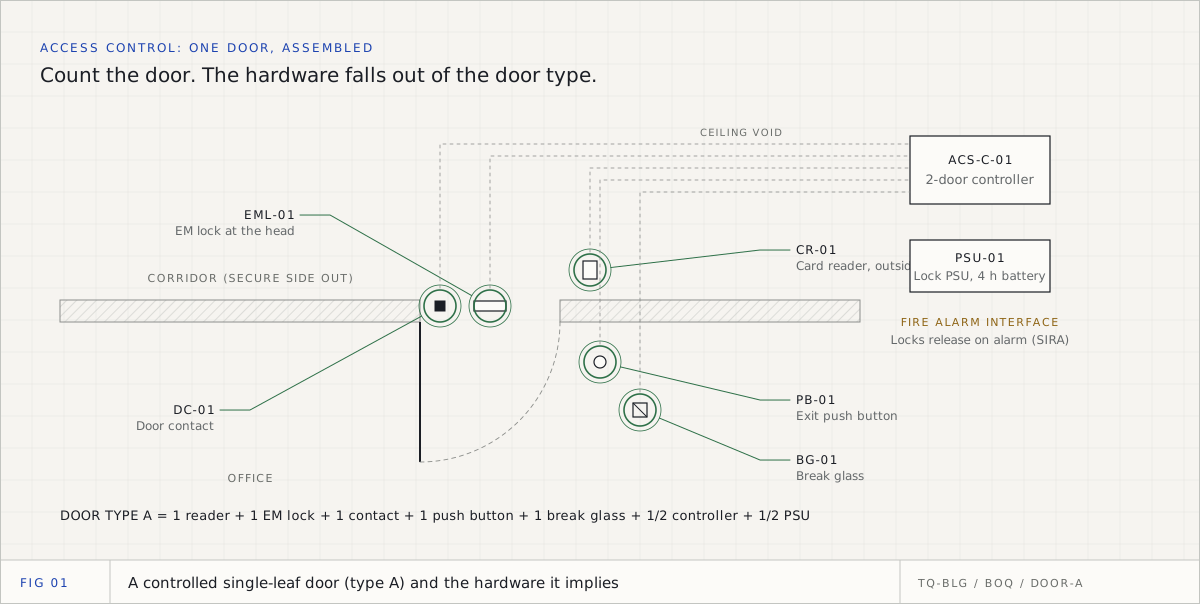
- Take off each system by type. Cameras by type, doors by hardware set, data points per floor. Typical floors are counted once and multiplied, with the multiplier written down.
- Derive what is not drawn. Recorders and storage, controllers and power supplies, switches, patch panels, racks, backbone, cable. The ELV estimating rules post covers how to keep these derivations the same from one tender to the next.
- Send requests for quotes early. The long-lead and high-value items first: cameras, recorders, access control hardware, switches, racks.
- Price each line. Material from vendor quotes, converted to AED. Installation from your own rates, per point, per run or per metre.
- Add the authority minimums. In Dubai, SIRA's specification requires recording for at least 31 days, recording devices and network devices computed with 20% extra capacity, and UPS for at least 30 minutes. These are lines, not notes. The CCTV BOQ for Dubai post works through them.
- Write the qualifications and exclusions. Then review, sign off and submit.
A worked example of the timeline
Every number here is illustrative: a 15-working-day tender window for the CCTV, access control and structured cabling of a mid-rise office in Dubai. Use the order, not the days.
| Working days | Work | Output |
|---|---|---|
| 1 to 2 | Read the pack, register drawings, start the query list | Drawing register, first queries |
| 2 to 7 | Take-off and review, system by system | Reviewed counts per sheet |
| 3 | Requests for quotes on long-lead items | Requests sent to two or three vendors each |
| 7 to 8 | Approve counts, generate the BOQ | Draft BOQ with derived lines |
| 8 to 11 | Quotes back, convert, price | Priced BOQ, list of lines still to quote |
| 12 to 13 | Qualifications, exclusions, internal review | Commercial summary |
| 14 | Management sign-off | Approved price |
| 15 | Submit | Tender submitted |
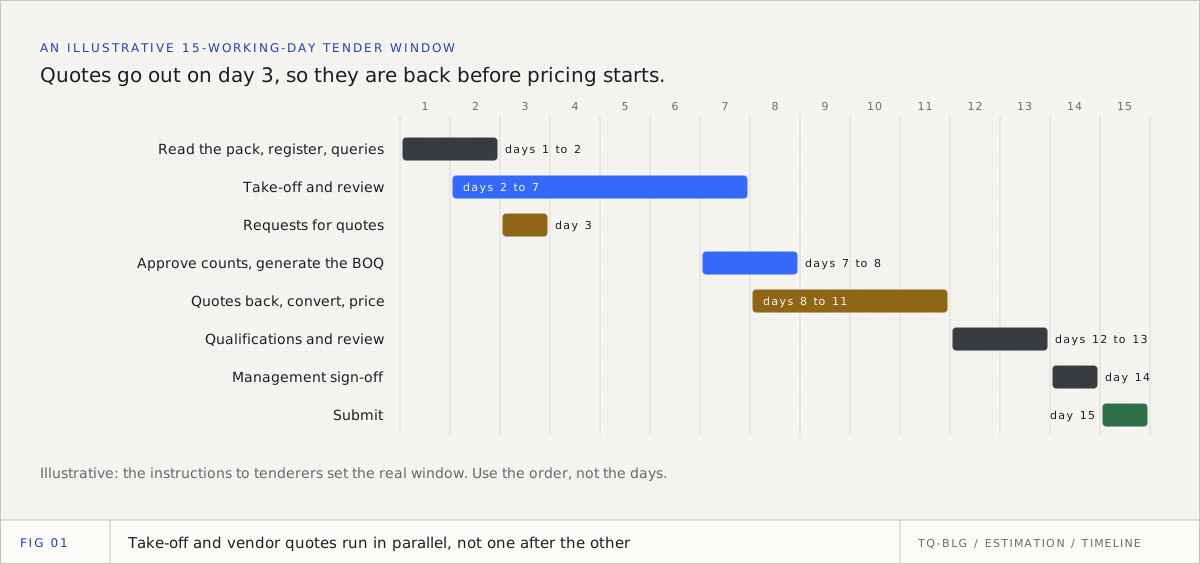
The point of the plan is that quotes and take-off run in parallel. A team that waits for the BOQ before asking vendors for prices loses a week.
Pricing in AED: the peg, the euro and the rate you state
UAE tenders are priced in dirhams, but ELV equipment is quoted in whatever currency the distributor buys in. Cameras and switches often come in US dollars, some access control and software lines in euros, and cable and containment from local stock in dirhams.
The dollar is fixed. The dirham is pegged to the US dollar at 3.6725 dirhams per dollar. The Central Bank of the UAE uses 3.6725 as its reference spot price for USD against AED, and its published rate tables carry the same figure day after day. A USD quote converts at 3.6725 with no currency risk.
The euro floats. The Central Bank's table of exchange rates for VAT obligations gave the euro as 4.231478 dirhams on 3 August 2026, and it moves every day. So for a euro quote you choose a working rate, write down its date, and state it in your qualifications. Some firms round it up a little to cover movement between the bid and the order; that is a commercial decision, and it should be visible, not buried.
Worked example: three quotes, one AED price
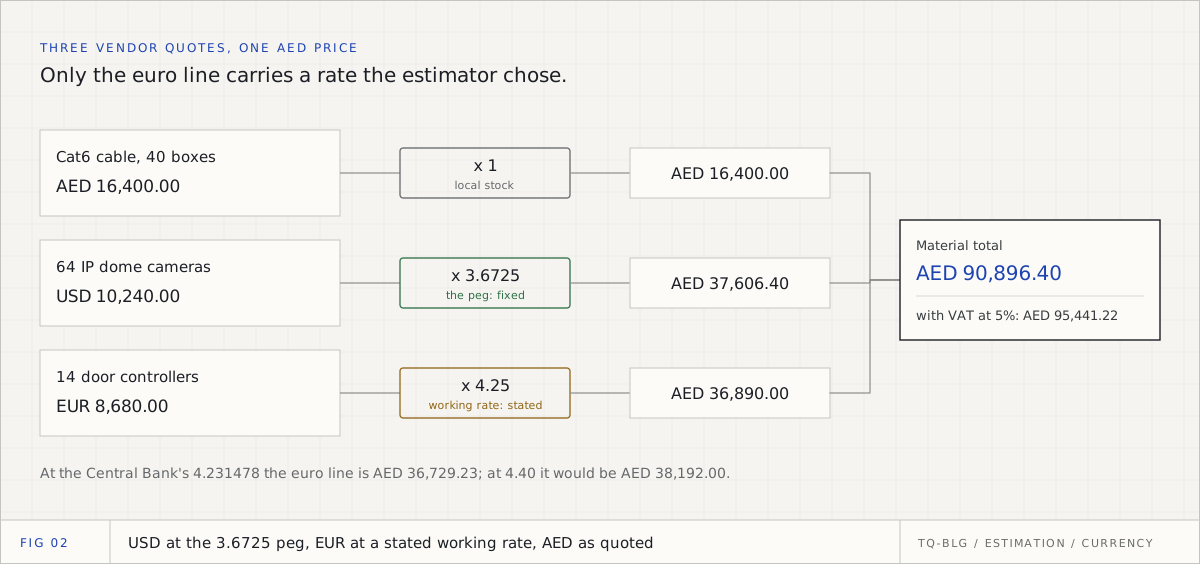
Illustrative quotes for the material in the example package. The working euro rate of 4.25 is the estimator's choice, rounded up from the Central Bank's 4.231478.
| Vendor quote | Currency | Quote total | Rate to AED | AED |
|---|---|---|---|---|
| Cat6 cable, 40 boxes of 305 m at 410 per box | AED | 16,400.00 | 1 | 16,400.00 |
| 64 IP dome cameras at 160 each | USD | 10,240.00 | 3.6725 (peg) | 37,606.40 |
| 14 door controllers at 620 each | EUR | 8,680.00 | 4.25 (working rate) | 36,890.00 |
| Material total | 90,896.40 | |||
| VAT at 5% | 4,544.82 | |||
| Material total with VAT | 95,441.22 |
What the rate choice is worth here: at the Central Bank's 4.231478 the euro line would be AED 36,729.23, so the rounded rate carries AED 160.77 of cushion. If the euro reached 4.40 before the order, the same line would cost AED 38,192.00, which is AED 1,302.00 more than the price you bid. On a single line that is small. On a package where half the material is in euros, it is your margin.
VAT
UAE VAT was introduced on 1 January 2018 at a standard rate of 5%. Follow the form of tender on whether rates include it. Where it does not say, price excluding VAT, show VAT as its own line, and say so in your qualifications.
Quote validity against tender validity
A vendor quote is usually valid for a shorter period than the tender. If the instructions to tenderers say your price must stand for, say, 90 days and the camera quote expires in 30, you are carrying the price risk for 60 days. Three ways to handle it:
- Ask the vendor to hold the price for the tender validity, in writing.
- Add a stated allowance for the gap.
- Qualify the price: material prices are based on quotes valid to a given date.
Do not price from an expired quote. It is the most common way last year's prices reach a new bid.
Approved makes, and choosing a vendor who is not the cheapest
UAE specifications usually list the approved manufacturers for each system. Price the cheapest compliant option first. When you choose another, because the client prefers a brand, the cheapest vendor's lead time does not fit the programme, or the consultant has approved only one make for a system, write down why. A reviewer reading your bill a week later needs the reason, not just the vendor name.
Qualifications and exclusions
The qualifications are where the estimate becomes defensible. For an ELV package in the UAE, the usual list covers:
- Drawings priced: the register, by sheet and revision.
- Typical floors: which floors were priced from one drawing, and the multiplier.
- Rates: USD at the 3.6725 peg; any other currency at the stated working rate and date.
- VAT: included or excluded.
- Quote validity: the dates material prices rely on.
- Exclusions: typically civil and builder's works, containment if it is by others, power to racks and devices, authority fees, and the telecom provider's connection. Check every one against the specification before excluding it.
- Lines not priced: anything still to quote, listed by name, so nobody reads the total as complete.
Software cost in AED: per seat or per department
The cost of estimating software in the UAE depends on how it is priced. Per-seat tools charge for each user, so the cost is seats times the monthly price times twelve, and every reviewer you add raises it. In our take-off software comparison, built from each vendor's own pricing page on 14 October 2026, published per-seat prices for a five-person team ranged from about AED 15,000 to AED 66,000 a year.
TrueQty charges one subscription per estimating department, in AED with no VAT added, monthly or annually with two months free. Every plan includes every ELV discipline: security and ICT are counted from the drawings, and the others run on your own BOQ in the same project.
| Plan | AED per month | Seats included | Tenders per month |
|---|---|---|---|
| Starter | 990 | 2 | 2 |
| Professional | 2,900 | 6 | 6 |
| Enterprise | from 6,000 | 12 or more | Unlimited |
An extra seat on Starter or Professional is AED 350 a month. For a five-person team on Professional, that is AED 29,000 a year billed annually. It is not like for like: general take-off tools cover every trade, while TrueQty covers ELV and prices the BOQ and the proposal. See pricing for the current plans.
Where your tender drawings are stored
Tender drawings are your client's information, and many UAE clients ask where they are kept. The UAE's Personal Data Protection Law (Federal Decree-Law No. 45 of 2021) sets requirements for transferring personal data across borders, and a tender folder often carries names, signatures and contact details in its title blocks and transmittals. Ask any software vendor in writing where drawings are stored and which other companies process them. TrueQty stores data in Dubai, on Oracle Cloud's UAE East (Dubai) region.
How TrueQty does the pricing step
In TrueQty the pricing step runs from your vendors' own price lists:
- Add each vendor with the currency they quote in. AED is the default. See add a vendor and a price list.
- Upload their price list (Excel, CSV or PDF) with its valid-until date. A list past that date stops pricing anything until you extend it.
- Check what it read, and correct any price, stock flag, currency or date. See check and correct a price list.
- Set the rates by hand in Settings, under Currency rates: one rate per currency for the workspace, with an as-of date, never looked up online. The dollar is preset at the peg, 3.6725. A vendor whose currency has no rate is left out of pricing, and the line says so.
- Price the bill. Every line takes the cheapest vendor whose item matches, is in stock and is in date. Lines it cannot price are shown with the reason, and nothing is guessed. You can type a rate by hand (per run, per metre, or per 305 m box for copper cable), choose another vendor with a reason, or leave a line to quote. See price the BOQ.
- Each priced line keeps the rate it was priced at. Changing a rate in Settings never moves a bill you have already priced; it applies when you price again.
- Make the proposal as a PDF, or as an editable Word file on Professional and above, with lines still to quote listed under the total.
The quantities underneath come from drawings sent for pricing only: every count traces to a spot on the drawing, and a person approves it. The how it works page shows the whole chain.
Checklist before you submit
- Every drawing in the register is priced, at the revision in the latest addendum.
- Every query reply and addendum is read into the estimate.
- Every USD line is at 3.6725, and every other currency at one stated rate with its date.
- No line is priced from an expired quote.
- VAT treatment matches the form of tender.
- Authority minimums (SIRA retention, extra capacity, UPS time) are priced lines.
- Lines still to quote are named in the qualifications.
- Someone senior has read the qualifications, not just the total.
A UAE ELV estimate is won or lost on things that are easy to check and easy to forget: the revision, the rate, the validity date, the line nobody priced. Write each of them down where the next reader will find it, and the price you submit is one you can defend.
Take off one real ELV sheet, with the evidence for every count on the drawing.
14 days, one full ELV tender, no card. Sign up with your work or personal email. You check every count, a team lead approves each sheet, and only approved sheets reach the BOQ.
Questions engineers ask
- Q01What does an ELV estimator do in the UAE?
- An ELV estimator turns a consultant's tender pack into a priced bid for the extra-low-voltage systems: CCTV, access control, structured cabling, intercom, and often fire alarm, public address and AV. The work is reading the tender documents, taking quantities off the drawings, deriving the items the drawings imply, getting vendor quotes against the approved makes, converting them to AED, and writing the qualifications and exclusions that go with the price.
- Q02What exchange rate should I use for a USD quote in a UAE tender?
- The dirham is pegged to the US dollar at 3.6725 AED per dollar, the rate the Central Bank of the UAE uses, so a USD quote converts at that rate without currency risk. Euro, pound and other quotes float. Choose a working rate, write it down with its date, and state it in your qualifications so everyone knows what the price assumed.
- Q03Are ELV tender prices in the UAE quoted with or without VAT?
- Follow the form of tender. UAE VAT has been charged at a standard rate of 5% since 1 January 2018, and a bid should say plainly whether its rates include it. If the form does not say, price excluding VAT and show the VAT amount on its own line.
- Q04How long does an ELV tender estimate take?
- As long as the tender window allows, which the invitation to tender sets. The work that takes longest is the take-off and the vendor quotes, so send requests for long-lead and high-value items in the first week and keep the take-off moving in parallel. Leave the last days for review, qualifications and sign-off.
- Q05Is take-off software priced per seat or per company in the UAE?
- Both models exist. Per-seat tools charge for each estimator and reviewer, so the cost grows with the team. TrueQty charges one subscription per estimating department in AED, priced on tenders a month and seats, with 2, 6 or 12 or more seats included depending on the plan and every ELV discipline in each. No VAT is added: TrueQty is not VAT-registered.
Sources
Every external fact in this document is cited to one of these, fetched when it was written.
- [01]Central Bank of the UAE, Exchange rates against UAE Dirham for VAT related obligations, August 2026centralbank.ae
- [02]Central Bank of the UAE, Foreign Exchange Swaps Facility terms and conditions (USD/AED reference spot 3.6725)centralbank.ae
- [03]UAE Ministry of Finance, Value Added Tax (VAT)mof.gov.ae
- [04]SIRA, Standard and Technical Specifications of the Security Systems, Version 4.0 (2022)sira.gov.ae
- [05]Dubai Civil Defence, UAE Fire and Life Safety Code of Practice (September 2018)dcd.gov.ae
- [06]TDRA, Building Telecommunications Network Specification Manual, third edition (May 2024)tdra.gov.ae
- [07]UAE Government portal, Data protection laws (PDPL)u.ae
- [08]Oracle Cloud Infrastructure, Regions and Availability Domains (UAE East, Dubai)docs.oracle.com

Zakaria is a mechanical engineer and the co-founder and COO of AI Agentiva in Dubai. He builds TrueQty, and writes here about how ELV quantities are counted, checked and priced, and where take-offs go wrong.
Related documents
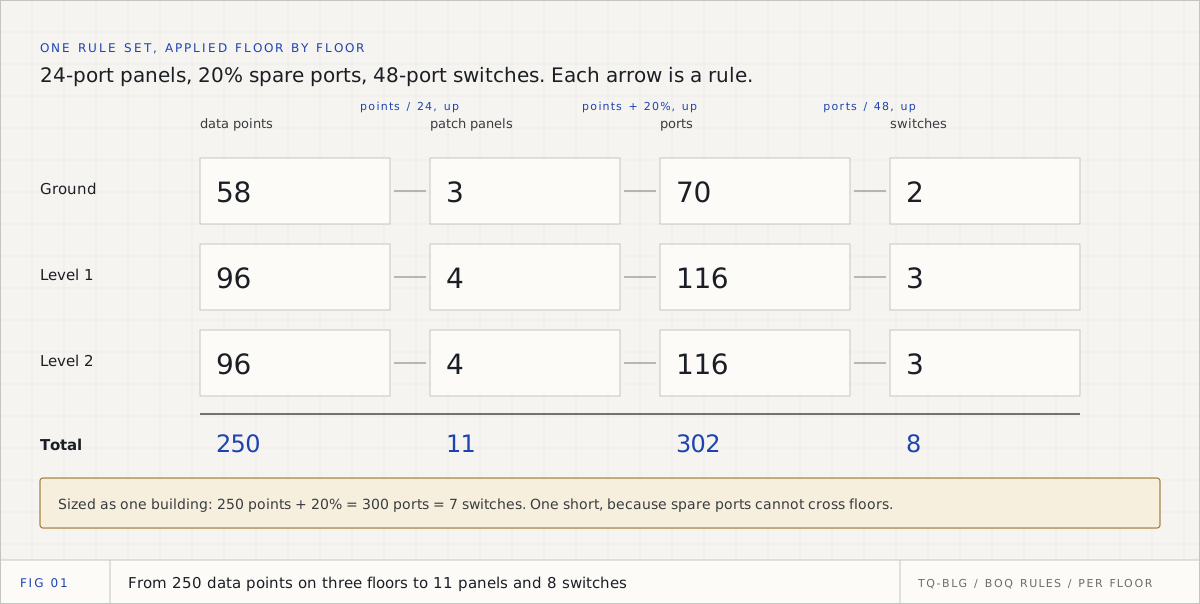
ELV estimating rules: how GCC contractors standardise the BOQ assumptions behind every derived line
The rules that turn counted devices into switches, patch panels, organisers, backbone and cable decide most of an ELV bill. How contractors in the UAE, Saudi and Qatar write them once per firm, override them per project with a reason, and trace every derived line to its formula, with a worked example.
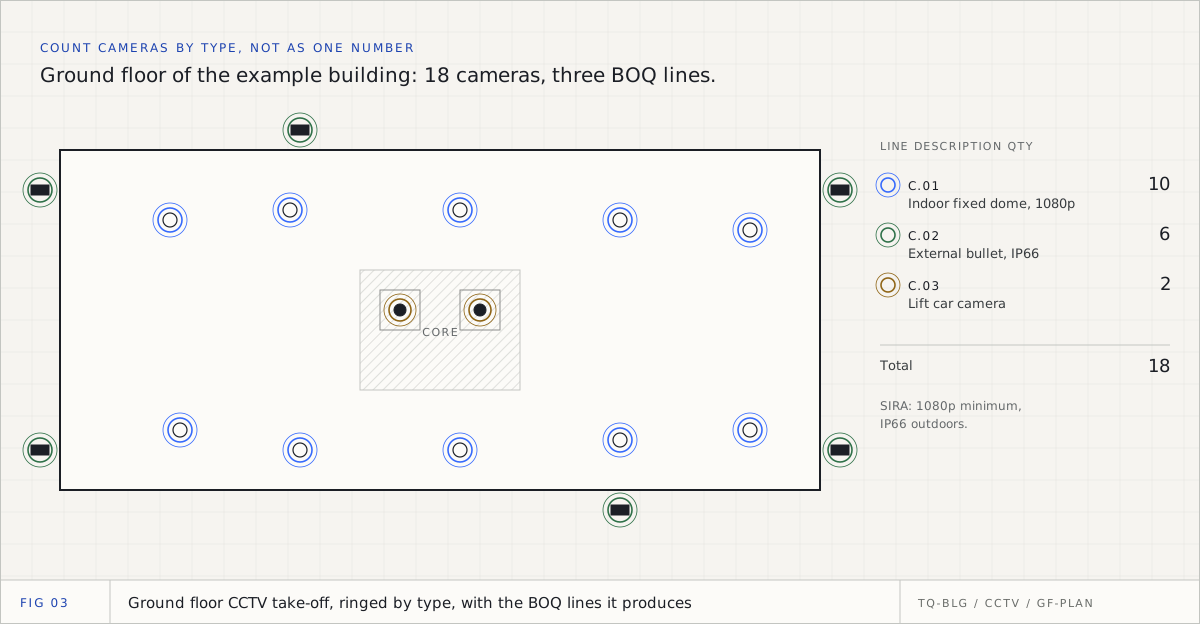
CCTV BOQ in Dubai: how to take off cameras, recorders and storage to SIRA rules
A CCTV bill of quantities in Dubai is mostly lines that are not drawn: recorders, storage, switches, power, cable, the UPS. This is how to get each one from the camera count, and which numbers SIRA fixes for you.
How to build an ELV BOQ from drawings: a worked example across CCTV, access control and structured cabling
A worked example that takes one illustrative office building from drawings to a bill of quantities across three systems, with the basis of every number written next to it and a sample BOQ table you can reuse.