
Quantity take-off software for ELV contractors in 2026: an honest comparison
The real options for an ELV estimating team in the GCC, from spreadsheets to general AI take-off tools to ELV-specific software, judged on the criteria that decide an ELV purchase. Vendor facts fetched from their own pages on 14 October 2026, with links, and TrueQty assessed with its limits.
- Doc no
- TQ-BLG-261014-92
- Rev
- Issued
- Author
- Zakaria Syed
- Category
- Software
- Reading
- 9 min
The best quantity take-off software for ELV contractors does ELV reasoning as well as symbol matching: it splits cameras by type, assembles access-controlled doors from their hardware, aggregates outlets into panels and switches, calculates cable with stated assumptions, shows the evidence behind every count, and lets a named engineer approve quantities before they are priced. For GCC teams, add where the drawings are stored and how the price scales with headcount. This comparison applies those criteria to the real options, using each vendor's own pages as fetched on 14 October 2026.
A disclosure first: TrueQty is our product. It is assessed below on the same criteria as everyone else, including where it falls short. No vendor paid for or reviewed this page.
How this comparison was made
- Every competitor fact comes from the vendor's own website, fetched on 14 October 2026 and checked against the page source. Each is linked in the sources list. Vendors change their sites; check the current page before you buy.
- "Not stated" means the page did not say it, not that the product lacks it.
- Prices are list prices in USD as published, converted at the fixed AED peg of 3.6725 to the dollar.
- Ducta was on our list but could not be researched: none of its domains answered, so it is not included.
- Products for AV and security integrators that build proposals without taking quantities off drawings (D-Tools, Jetbuilt, Portal.io and similar) are out of scope.
The criteria that matter for ELV
- ELV-aware counting. Does it know a door is an assembly, that camera types matter, that tags carry the type?
- Evidence. Can you click from a quantity to the mark it came from?
- Review and approval. Is there a gate between "counted" and "priced", with a named approver?
- Difficult drawings. What happens with flattened exports, scans and missing legends? (The background is in take-off from difficult drawings.)
- Cable. Does it calculate lengths with stated assumptions and check the 90 m limit? (See the ELV cable calculation guide.)
- Output. Quantities only, a priced BOQ, or a client proposal?
- Data residency. Where are drawings stored, and is a GCC region stated?
- Pricing model. Per seat, per company or per trade, and in what currency?
The options
Spreadsheets and CAD
This is still how most ELV tenders in the region are priced, and pre-sales job advertisements routinely ask for AutoCAD and Excel. With reason: they are flexible, free at the margin, and every client accepts the output. Counting is manual (or CAD block counts, when the DWG is available and clean), derived items are formulas someone wrote years ago, and evidence is whatever the estimator marked up on a PDF. The weakness is not speed alone; it is that nothing records why a number is what it is, and nothing stops an unchecked number reaching the price.
General AI take-off tools
These are multi-trade tools with automatic counting and measuring. ELV is one trade among many.
- Togal.AI says it "automatically detects, measures, and compares directly from your drawings", with a stated accuracy figure on its home page. Growth plan: USD 299 a month per user, billed yearly.
- Kreo is cloud take-off with an Auto Count feature that points at one element and finds matching ones across the project, with results exported as reports and BoQ. Lite, Plus and Pro plans at USD 35, 70 and 175 per user per month, billed annually, with a 7-day trial.
- STACK is a cloud preconstruction platform with take-off, estimates and proposals. Its pricing page lists Takeoff and Estimate "as low as" USD 299 per user per month, and a free version.
- PlanSwift offers take-off with Auto Count (point at one instance of a symbol and find every match) and assemblies for pricing. Essential USD 2,000 and Core USD 3,000 per seat per year, with a 14-day trial.
- Beam AI sells take-off as software you run yourself (from USD 8,000 a year per trade) or done for you (from USD 25,000 a year).
- Square Takeoff is online measuring software at USD 249 a month or USD 1,699 a year.
In practice these are strong measuring tools, and their automatic counting is good at finding repeated shapes. None of the pages we read describes ELV reasoning such as door assemblies or tag-based camera types; expect to build that grouping yourself. The comparison favours them when your team prices several trades in one tool.
PDF markup and measurement
Bluebeam Revu is the PDF tool most estimators already have. Its pricing page lists count and length measurement among the plan features; plans run from USD 260 to USD 590 per user per year, billed annually. It is a markup and measurement tool rather than an estimating system. It is also the only vendor here that publishes its cloud regions, and its region page lists no Middle East region.
ELV-adjacent specialists
- Countfire is the closest specialist: PDF take-off whose listed sectors include electrical, security and fire alarm, and data and AV. Its security page covers CCTV, access control, intruder detection and fire detection, and counts devices such as PIRs, door contacts, panic buttons and keypads. It offers a 7-day free trial; no price is published on its site, and its pricing link leads to a contact form.
- Cable Takeoff focuses on structured cabling: it measures each cable run along the hallway path back to its IDF, checks the design against TIA, BICSI and NEC limits, and produces a branded proposal. Solo USD 49.99 to Team USD 199.99 a month (three seats), with a 14-day trial. Its standards and units are North American.
TrueQty
TrueQty is ELV-only take-off for GCC contractors, built in Dubai.
What it does: reads vector PDFs by the CAD layer names kept inside them, their legends and device tags, reads flattened PDFs from their geometry, infers access-controlled doors from the hardware drawn around them, and counts by category across CCTV, access control, intercom, data outlets and racks. Every detection carries its evidence (file, page, layer, tag), review happens by category, coverage flags ask a person to look at likely misses, and only a team lead or admin can approve a sheet's counts, enforced on the server. Typical floors multiply only after a named approval, and only on a sheet whose title block states its floor. A team lead can teach an unknown layer, symbol or tag code once, and it is counted on that firm's later sheets. From the approved sheets it builds a versioned BOQ with rules-based cabling and switch ports read from a checked PDF riser, BOQ by floor in the main contractor's columns, a cable schedule that shows its arithmetic, supplier pricing from your own price lists, markup overall, per package or per line, and a proposal at sell price (PDF on every plan, Word on Professional and Enterprise) with a client Excel copy that shows no cost or vendor. A project carries every ELV discipline as a package (security and ICT counted from the drawings, the rest from your own BOQ), each taken off by its own team, and the estimating lead joins their BOQs into one. Data is stored on Oracle Cloud's Dubai region; the security page lists what can leave it.
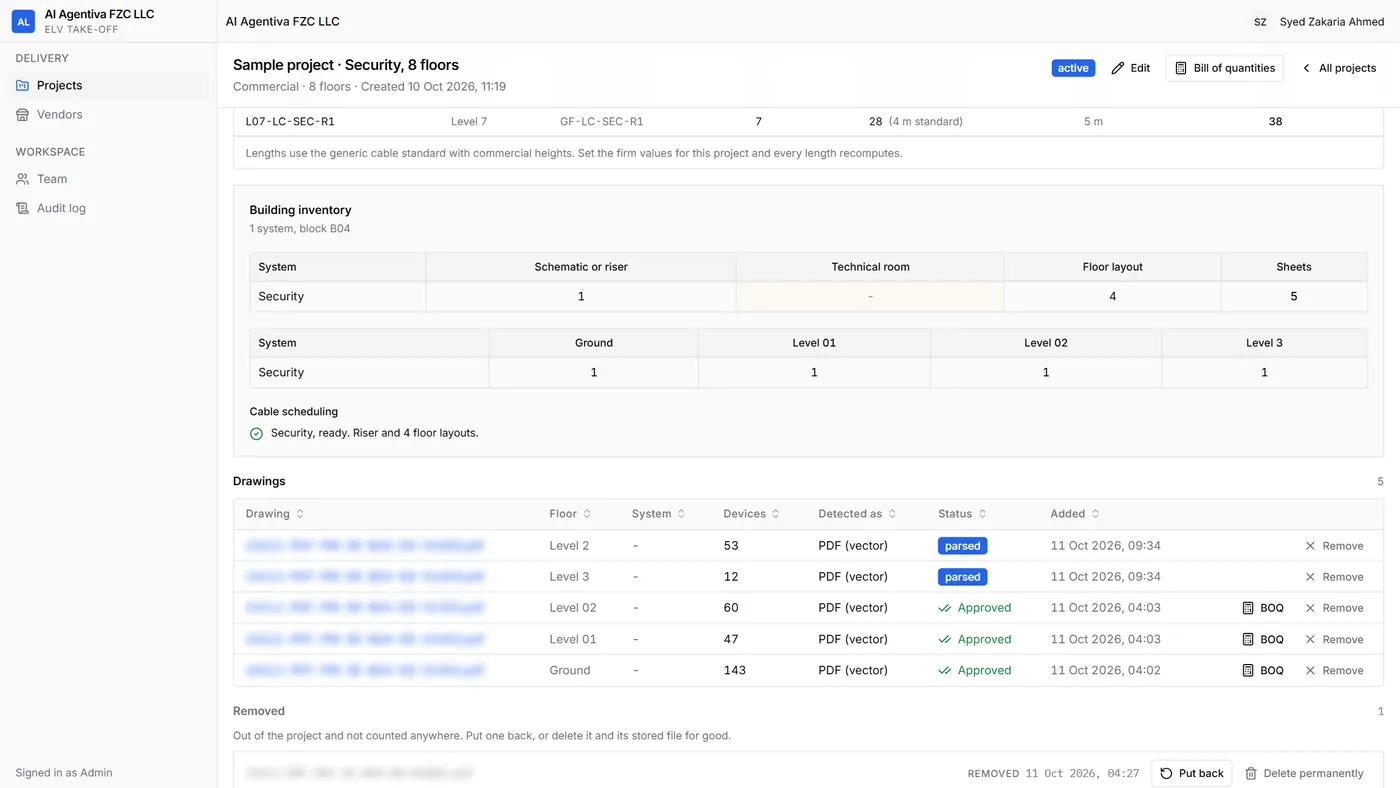
Where it falls short, today:
- ELV only. It does not take off other trades.
- Recognition is narrower than the review screen. Fire alarm, AV and home automation devices are counted by hand in the same review workflow. PA speakers are read only where the sheet's legend confirms them; background music speaker types are counted by hand.
- Drawing formats. DWG and DXF files are read but cannot be shown for checking, so their counts stay out of the BOQ until the sheet has a PDF: one exported from CAD (the most accurate) or one TrueQty converts, checked carefully. Risers and schematics are kept as reference, not counted. Scanned sheets go through recognition, where a person seeds one symbol and names each group, rather than fully automatic reading.
- The first sheets from a new consultant take longer. Layers, symbols and tag codes the software cannot name are shown for a team lead to name once; until then those devices are counted by hand or left generic.
- No Arabic interface yet, no RFQ module, and monthly billing only. Supplier price lists with Arabic headers are read.
- Young product. Fewer integrations and less track record than vendors that have been selling for years.
Side by side
| Spreadsheets and CAD | General AI take-off (Togal, Kreo, STACK, PlanSwift) | Bluebeam Revu | Countfire | Cable Takeoff | TrueQty | |
|---|---|---|---|---|---|---|
| ELV-aware counting | Manual | Symbol matching; ELV grouping by hand | Manual count tools | Security and fire devices named | Structured cabling | Layers, tags, door assemblies |
| Evidence per quantity | Markups, if kept | Varies by tool | Markups | Not stated | Not stated | Every count links to its mark |
| Approval gate before pricing | None | Not stated | None | Not stated | Not stated | Named team lead or admin, server-side |
| Cable calculation | Formulas | Manual linear measure | Manual measure | Not detailed | Path-routed to IDF, standards checks | Formula per run, 90 m flag |
| Output | Anything | Quantities; STACK adds estimates and proposals | Quantities to Excel | Quote and proposals | BOM and proposal | BOQ by floor, cable schedule, priced BOQ, proposal at sell price |
| Stated GCC data region | Your servers | Not stated | No Middle East region listed | Not stated | Not stated | Oracle Cloud Dubai |
| Arabic interface | Yes (Excel) | Not stated | Not stated | Not stated | Not stated | No |
| Pricing model | Licences you own | Per user | Per user per year | Quote | Flat, seats included | Per department, seats and tenders included |
Per seat or per department: the arithmetic for a five-person team
ELV estimating is a team sport: a junior counts, a senior reviews, a manager approves, procurement prices. Per-seat pricing charges for every one of them. Annual list cost for five users, from the pages above, converted at AED 3.6725 to the dollar:
| Product and plan | Published price | Five users, per year | In AED |
|---|---|---|---|
| Togal.AI Growth | USD 299 per user per month, billed yearly | USD 17,940 | AED 65,885 |
| STACK Takeoff and Estimate | USD 299 per user per month | USD 17,940 | AED 65,885 |
| PlanSwift Core | USD 3,000 per seat per year | USD 15,000 | AED 55,088 |
| Kreo Pro | USD 175 per user per month, billed annually | USD 10,500 | AED 38,561 |
| TrueQty Professional | AED 2,900 a month, or AED 29,000 a year billed annually; 6 seats included | AED 29,000 (AED 34,800 billed monthly) | |
| Kreo Plus | USD 70 per user per month, billed annually | USD 4,200 | AED 15,425 |
| Bluebeam Revu Core (markup and measure) | USD 330 per user per year | USD 1,650 | AED 6,060 |
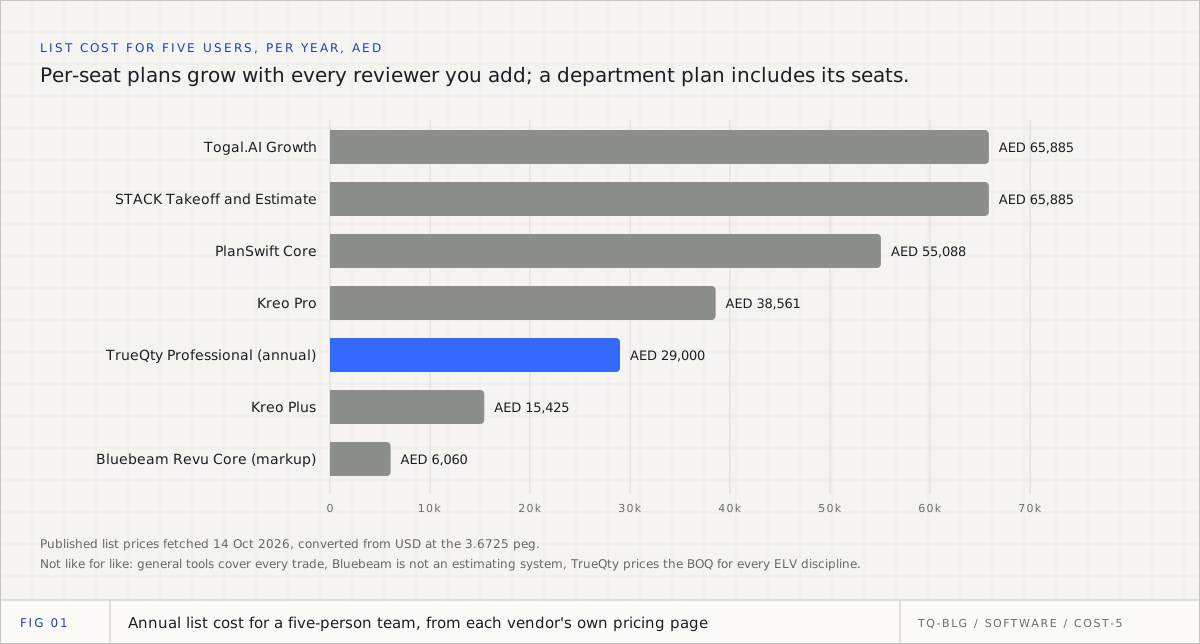
The comparison is not like for like, and should not be read as one: the general tools cover every trade, Bluebeam is not an estimating system, and TrueQty prices the BOQ and the proposal for every ELV discipline, counting security and ICT from the drawings and taking the others from your own BOQ. It does show the structural point. On a department plan, the reviewer and the approver are seats already paid for, which matters when approval is the step you most want people to do. TrueQty's pricing page has the plans: Starter, Professional and Enterprise, priced on tenders a month and seats, with nothing charged per drawing.
Which to choose
- You price several trades in one team. A general take-off tool. Shortlist two, run the same multi-trade tender through both.
- You price ELV outside the GCC, to British or North American standards. Countfire for security and fire, Cable Takeoff for structured cabling (its checks follow TIA, BICSI and NEC).
- You price ELV tenders in the GCC and must defend every number. Look for ELV reasoning, evidence per quantity, an approval gate, AED pricing and a stated in-region data location, and hold every candidate, ours included, to all five. For pricing a UAE tender end to end, see ELV estimation in the UAE.
- You are a two-person team on spreadsheets that rarely sees a large tender. Stay on spreadsheets until the rework costs more than the software, and adopt the verification checks from the ELV quantity take-off guide either way.
Whatever you shortlist, test it on one of your own real drawings, ideally a difficult one, and ask each vendor two questions in writing: where are my drawings stored and processed, and how do I see why a quantity is what it is? Under the UAE's Personal Data Protection Law, in force since January 2022, cross-border transfers of personal data have rules of their own, so the first answer matters beyond preference.
Take off one real ELV sheet, with the evidence for every count on the drawing.
14 days, one full ELV tender, no card. Sign up with your work or personal email. You check every count, a team lead approves each sheet, and only approved sheets reach the BOQ.
Questions engineers ask
- Q01What is the best take-off software for ELV contractors?
- It depends on what your team spends its time on. For a team that prices CCTV, access control and structured cabling for GCC tenders and needs to defend every quantity, choose a tool that understands ELV assemblies, shows the evidence behind each count, gates pricing behind approval, and keeps data in the region. For a multi-trade estimating department, a general take-off tool with good manual measurement may fit better. Run the same real drawing through two or three shortlisted tools before deciding.
- Q02Can general AI take-off tools count CCTV and access control devices?
- Most can find repeated symbols, usually by pointing at one instance and searching for matches. What they generally do not do is ELV reasoning, such as assembling an access-controlled door from its reader, lock, contact, button and break glass, or splitting cameras that look alike but carry different type tags. Expect to do that grouping yourself and check it.
- Q03Is per-seat or per-company pricing cheaper for an estimating team?
- It depends on team size. Per-seat pricing scales with every estimator and reviewer you add; a department plan includes a set number of seats. For a five-person ELV team, published per-seat take-off prices on 14 October 2026 ranged from about AED 15,000 to AED 66,000 a year, against AED 29,000 a year for TrueQty Professional billed annually, which includes six seats, six tenders a month and every ELV discipline.
- Q04Which take-off tools keep data in the UAE?
- None of the general take-off vendor pages we fetched on 14 October 2026 stated a Middle East hosting region. Bluebeam is the only one that publishes a list of regions for its cloud, and the list has no Middle East region. TrueQty stores data on Oracle Cloud's Dubai region. Ask any vendor in writing where drawings are stored and processed, and which subprocessors can see them.
- Q05Do I still need Excel if I buy take-off software?
- Usually yes, for the commercial layer: margins, exclusions, client formats and approvals. What should leave Excel is the counting and the derived arithmetic, because that is where copy and paste errors hide. Pick a tool whose BOQ exports cleanly to Excel so the two fit together.
Sources
Every external fact in this document is cited to one of these, fetched when it was written.
- [01]Togal.AI, pricing (fetched 2026-10-14)togal.ai
- [02]Togal.AI, home page (fetched 2026-10-14)togal.ai
- [03]Kreo, pricing (fetched 2026-10-14)kreo.net
- [04]Kreo, home page (fetched 2026-10-14)kreo.net
- [05]STACK, pricing (fetched 2026-10-14)stackct.com
- [06]PlanSwift, pricing (fetched 2026-10-14)planswift.com
- [07]PlanSwift, home page (fetched 2026-10-14)planswift.com
- [08]Bluebeam, pricing (fetched 2026-10-14)bluebeam.com
- [09]Bluebeam, Studio regions (fetched 2026-10-14)support.bluebeam.com
- [10]Beam AI, pricing (fetched 2026-10-14)ibeam.ai
- [11]Square Takeoff, pricing (fetched 2026-10-14)squaretakeoff.com
- [12]Countfire, home page (fetched 2026-10-14)countfire.com
- [13]Countfire, security estimating software (fetched 2026-10-14)countfire.com
- [14]Cable Takeoff, home page (fetched 2026-10-14)cabletakeoff.com
- [15]Oracle Cloud Infrastructure, Regions and Availability Domainsdocs.oracle.com
- [16]UAE Government portal, Data protection laws (PDPL)u.ae
- [17]Wikipedia, United Arab Emirates dirham (USD peg)en.wikipedia.org

Zakaria is a mechanical engineer and the co-founder and COO of AI Agentiva in Dubai. He builds TrueQty, and writes here about how ELV quantities are counted, checked and priced, and where take-offs go wrong.
Related documents
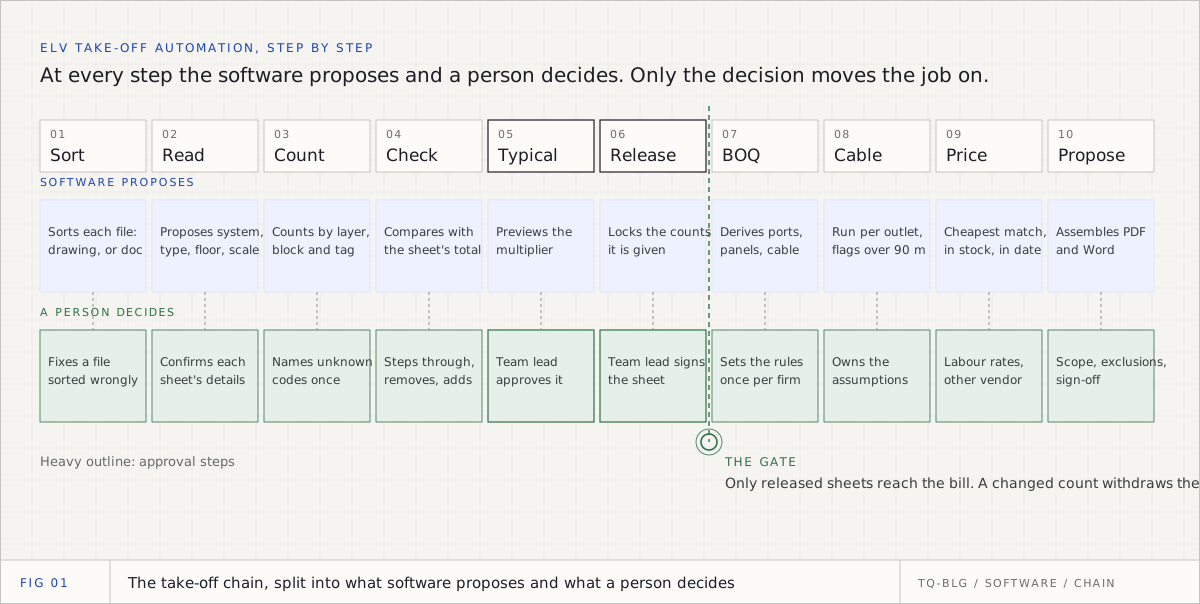
ELV take-off automation: what software can do, and what a person must still decide
Most of an ELV and security take-off can be automated: reading the drawings, counting tagged devices, deriving ports and panels, measuring cable, finding the cheapest vendor. Deciding is not. This is the chain, step by step, with a worked example of what a single unchecked miss does to the bill.
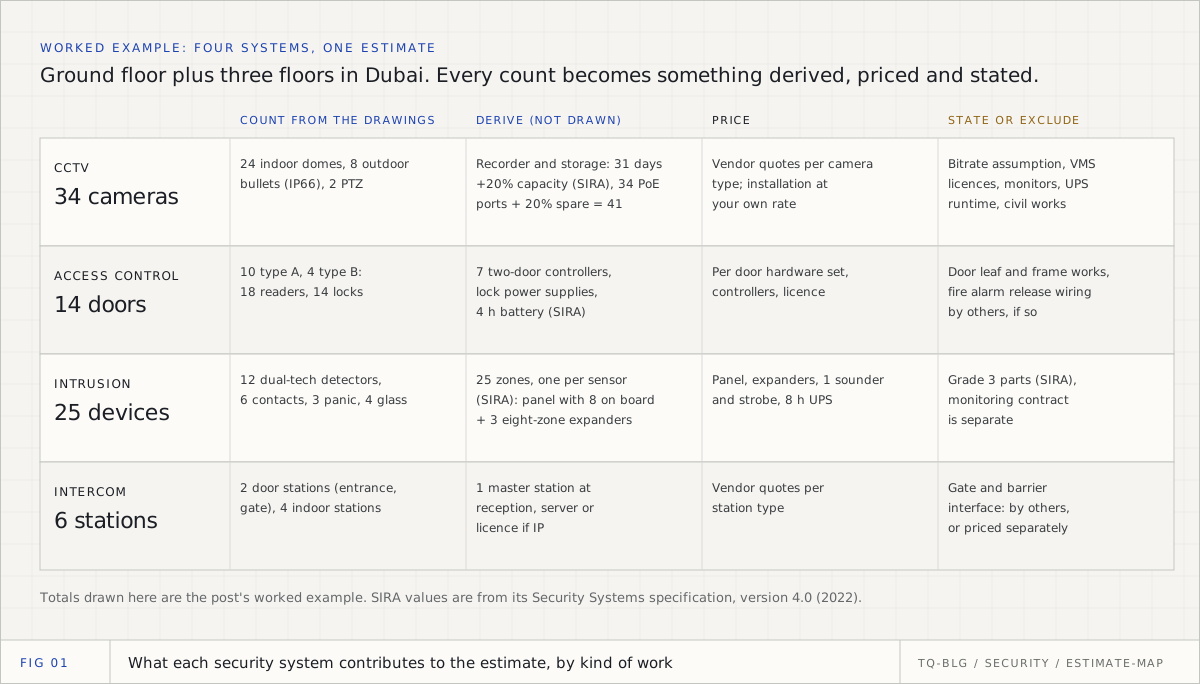
Security systems estimating: CCTV, access control, intrusion and intercom, from drawings to a priced bid
A security estimate is four kinds of work across four systems: count what is drawn, derive what is not, price both, and state what you excluded. This is the whole method for a GCC tender, with the SIRA rules that change the bill and a worked Dubai example from drawings to priced lines.
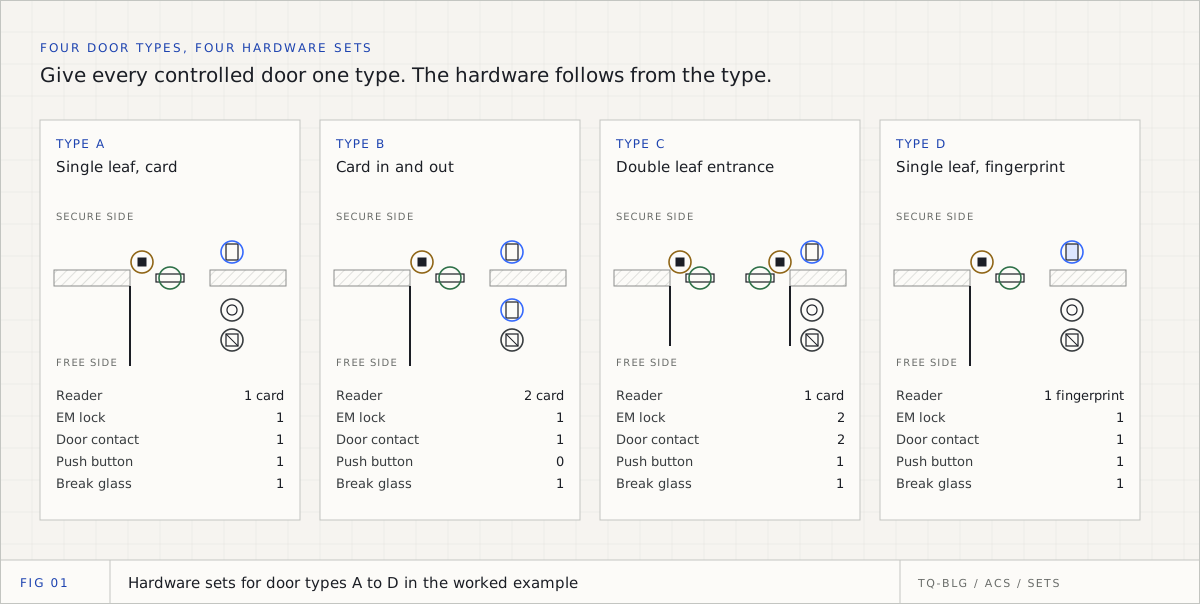
Access control take-off: doors, hardware sets and controllers from tender drawings
In access control the unit is the door, not the device. This is how to build hardware sets per door type, read the door schedule against the plans, count doors by type, derive controllers and power supplies, and check the result before it reaches the BOQ, with a worked 32-door example.