
Security systems estimating: CCTV, access control, intrusion and intercom, from drawings to a priced bid
A security estimate is four kinds of work across four systems: count what is drawn, derive what is not, price both, and state what you excluded. This is the whole method for a GCC tender, with the SIRA rules that change the bill and a worked Dubai example from drawings to priced lines.
- Doc no
- TQ-BLG-261022-IJ
- Rev
- Issued
- Author
- Zakaria Syed
- Category
- Software
- Reading
- 10 min
Security systems estimating is turning a tender's drawings and specification into a priced bid for CCTV, access control, intrusion and intercom: count every device that is drawn, derive the equipment those devices need but nobody drew, price both from vendor quotes and your own labour rates, and state what you excluded. In the GCC the authority shapes the bill as much as the consultant does: in Dubai, SIRA's specification fixes retention, battery and grading minimums, Saudi Arabia's 2022 camera law and Qatar's Security Systems Department set their own approvals, and a bid in AED often rests on vendor quotes in USD.
This is the estimating chapter of the ELV quantity take-off guide: the take-off gives you counts, and this post takes them to a priced proposal.
The four kinds of work in every security estimate
Every line in a security estimate comes from one of four kinds of work. Keeping them apart is what makes an estimate checkable.
| Kind of work | What it means | Example | Who should be able to check it |
|---|---|---|---|
| Count | A device drawn on the plans, counted by type | 24 indoor dome cameras | Anyone, by pointing at the drawing |
| Derive | Equipment the counts imply but the drawings do not show | 7 door controllers for 14 doors | Anyone, from the rule written beside it |
| Price | Material from vendor quotes, labour at your own rates | 24 domes at AED 684.92 | Procurement, from the quote |
| State or exclude | What the price assumes, and what it does not cover | Civil works by others | The client, from the proposal |
When a tender reviewer asks where a number came from, the answer should be one of those four, with the evidence. If the answer is "it is what we usually allow", the line is not estimated, it is remembered.
Read the tender pack before you count
Most expensive security errors are decided before the first camera is counted:
- The drawing register. Revision, floor and scale for every sheet, and which sheets are typical. Count Rev C while Rev D is issued and nothing after that matters.
- The specification. It names the device types, the recorder and retention, the reader technology and often the approved manufacturers.
- The door schedule. For access control it is often more reliable than the plan, and it tells you the door types.
- The riser schematic. It shows the head-end, the racks and what each floor connects to. It is the best cross-check on the plans.
- The authority. Find out which rules the facility falls under before you price anything, because they add lines.
| Country | Who sets the security rules | What it does to the estimate |
|---|---|---|
| UAE (Dubai) | SIRA, under Law No. 12 of 2016 and its specification, version 4.0 (2022) | Retention, recorder capacity, IP rating, battery and grading minimums become BOQ lines |
| Saudi Arabia | Ministry of Interior, under the surveillance camera law issued by Royal Decree in October 2022 | Covered facilities must have camera systems before a licence is granted or renewed |
| Qatar | Ministry of Interior, Security Systems Department (SSD) | Approval from SSD before cameras are installed; allow for the submission |
Fire alarm sits beside all of this. In the UAE the Civil Defence code governs the fire alarm, and SIRA requires access control to integrate with Civil Defence approved fire alarm systems and locks to open automatically in an emergency. That interface is a line someone has to price.
System by system: what to count and what to derive
CCTV
Count cameras by type, never as one line: indoor domes, outdoor bullets, PTZs, ANPR and specials, because each is a different price and a different power draw. Count camera poles and brackets separately where the drawings show them.
Derive the recorder and storage, the switch ports and PoE budget, the monitors and workstation, the VMS licences and the UPS. In Dubai, SIRA's specification requires recording for not less than 31 days, at least 70% of the day at not less than 10 frames per second for motion-based recording, and recorders sized with 20% extra capacity. Outdoor cameras must be rated at least IP66. The storage arithmetic and the PoE budget are worked through in the CCTV BOQ and SIRA guide, so they are not repeated here.
One PoE point catches estimators every time: size the switch for each camera's maximum power, not its typical power. Axis's guidance is that maximum power is the figure to use when selecting switches and power supplies. The PoE classes then decide what each port must deliver: IEEE 802.3af gives 13 W at the device, 802.3at gives 25.5 W, and 802.3bt gives 51 W (Type 3) or 71 W (Type 4), per the Ethernet Alliance overview. A PTZ with a heater can need an 802.3bt port, and that is a different switch.
Access control
Count doors, not readers. A controlled door is an assembly, and its type decides the hardware: reader, lock, door contact, exit button and break glass for a typical single door, and a second reader where the door is read in both directions. The ELV BOQ worked example draws one door assembly in full.
Derive the controllers from the door count and the controller size, the lock power supplies, the fire alarm release interface and the software licence. SIRA requires access control panels to carry a battery for at least 4 hours of operation after a mains failure, and lists the acceptable identification methods (PIN, cards, and fingerprint, retina or vascular readers); other readers need SIRA's written consent.
Intrusion
Count detectors, door contacts, glass break sensors and panic buttons. Where SIRA's intrusion requirements apply, all parts must be Grade 3 as a minimum, motion detection must be dual technology (infrared and microwave), and each sensor must be wired to the panel in its own zone.
Derive the panel and its zone expanders from the zone count, the external sounder and strobe (SIRA sets at least 110 dBA at 1 m), and the backup power: SIRA asks for 8 hours of UPS for the system and for the audio-visual alarm.
Intercom
Count door stations, indoor stations and any lift or refuge intercom shown on the plans. Derive the master station, which is often shown only on the riser, the server or licences for an IP system, the power supplies and the interface to gates or barriers. Make sure the gate interface is either priced or excluded, never neither.
Worked example: a Dubai office building
This is a worked example on an illustrative building, ground floor plus three floors, where SIRA's specification applies. All counts are from its tender drawings; all derived quantities follow from the rules stated in the table.
| System | Counted | Derived | Rule used |
|---|---|---|---|
| CCTV | 24 indoor domes, 8 outdoor bullets (IP66), 2 PTZ: 34 cameras | 41 PoE ports, so one 48-port PoE switch at the security rack | 34 ports + 20% spare, rounded up |
| CCTV storage | 34 cameras | About 38.2 TB usable, before RAID | 4 Mbps assumed, 70% of the day, 31 days, +20% (SIRA) |
| Access control | 14 doors: 10 type A, 4 type B | 18 readers, 14 EM locks, 14 contacts, 14 break glass, 10 exit buttons, 7 two-door controllers | Type A: 1 reader; type B: 2 readers; 2 doors per controller |
| Intrusion | 12 dual-tech detectors, 6 door contacts, 3 panic buttons, 4 glass break sensors: 25 devices | 25 zones: a panel with 8 zones on board plus 3 eight-zone expanders (32 zones), 1 sounder and strobe, 8 h UPS | One sensor per zone (SIRA) |
| Intercom | 2 door stations (entrance, car park gate), 4 indoor stations | 1 master station at reception | From the riser |
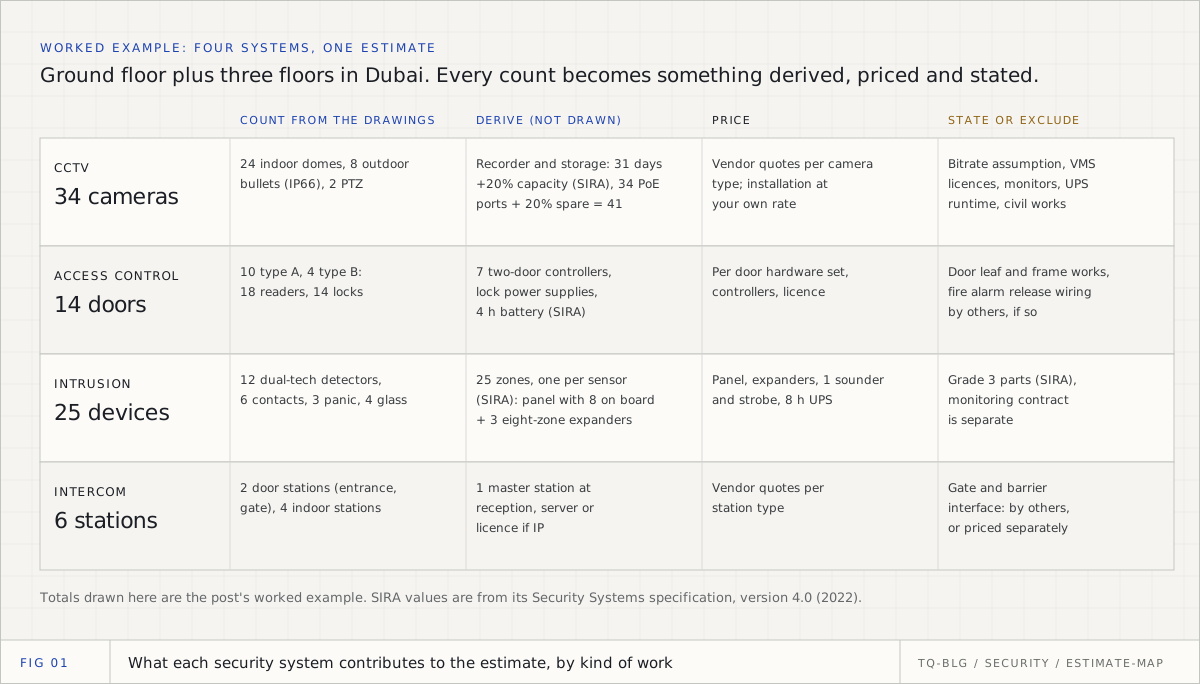
Notice how the derived column is where the money hides. Seven controllers, a 38 TB recorder, three expanders and an 8-hour UPS appear on no floor plan, and every one of them is a line a hurried estimate forgets.
Pricing: materials, labour and the gaps
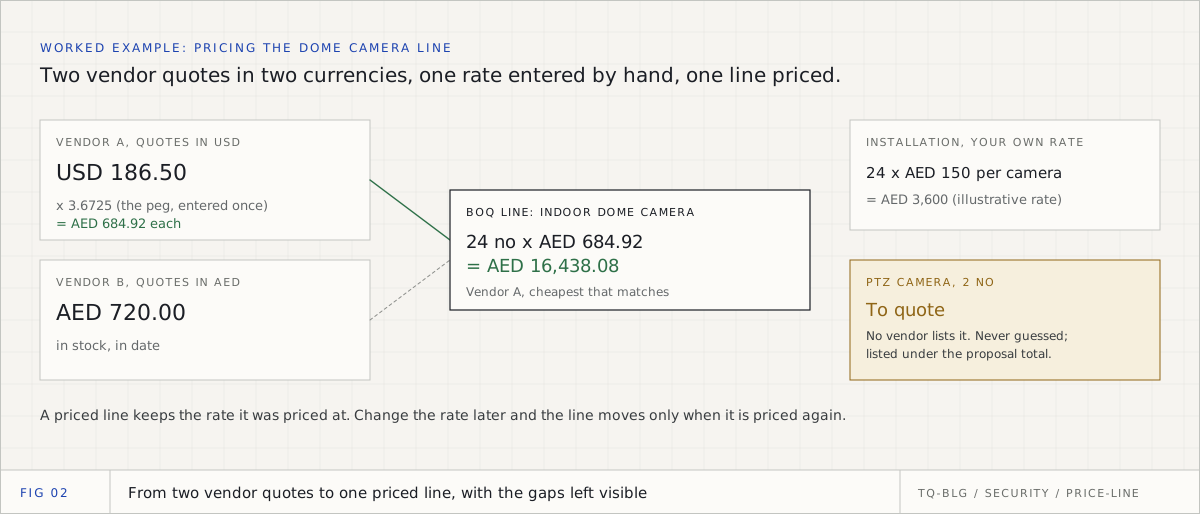
Materials come from vendor quotes, line by line. GCC vendors quote in AED, USD and EUR, so every foreign price needs a rate. Use the rate your firm has agreed for this bid, written down, not whatever a website says on the day. The dirham has been pegged at 3.6725 to the US dollar since 1997, which makes USD quotes predictable; EUR quotes are not.
Worked through for the dome camera line: vendor A quotes USD 186.50, which at 3.6725 is AED 684.92 each. Vendor B quotes AED 720.00, in stock and in date. Vendor A is cheaper, so the line is 24 x AED 684.92 = AED 16,438.08.
Labour is your own rate per device or per point: installation, termination, testing and commissioning. At an illustrative AED 150 per camera, the domes add AED 3,600. Keep labour as its own line so it can be compared with the next tender.
Gaps stay visible. In the example, no vendor lists the PTZ cameras, so that line is "to quote". It is never guessed, and the proposal lists it under the total.
Assumptions and exclusions to state
A security proposal is defended by its assumptions page. Write these down, every time:
- Assumptions: the bitrate, codec and recording mode behind the storage; the retention period and which rule requires it; spare ports and spare zones; cable lengths and the routing allowance behind them; the drawings and revisions priced from.
- Exclusions: civil works and core drilling; containment if it is by the electrical contractor; door leaves, frames and ironmongery by the door supplier; power to devices; the fire alarm side of the release interface; monitoring contracts; authority fees unless stated.
- To quote: every line no vendor priced, listed by name.
If a consultant's drawing and specification disagree, price one of them, say which, and raise the other as a tender query.
Checklist before the bid goes out
- Every device line traces to a counted device on a named sheet and revision.
- Cameras, readers and detectors are split by type, not lumped.
- Every derived line shows its rule: doors per controller, spare ports, zones per expander.
- Storage, battery and grading follow the authority that applies to this facility.
- PoE is sized from maximum power, and any PTZ or heated camera has the right port class.
- The fire alarm interface is priced or explicitly excluded.
- Every foreign currency price uses the rate written in the bid.
- Labour is priced separately from material.
- "To quote" lines are listed under the total.
- Assumptions and exclusions are in the proposal, not only in your spreadsheet.
How TrueQty does the estimating steps
TrueQty takes the counts from the reviewed drawings to a priced proposal. Only sheets a team lead has sent for pricing reach the bill, and every count traces to a spot on the drawing, approved by a person. For the take-off side, see ELV take-off automation.
- The bill. Generated from drawings sent for pricing: a line for each device type on each floor, plus the cable, patch panels, organisers, switches, racks and backbone those devices need, with the formula visible on each derived line and the firm's rules behind them. It does not size recorders, storage, door controllers, lock power supplies or alarm panels from rules. Where the drawings show them they are counted and reviewed like any device; otherwise work them out as above and add them when you finish the bill in the Excel export.
- Vendors and currency. Upload each vendor's price list, with the vendor's currency. Rates are entered by hand in Settings, never looked up online, with the dollar preset at the dirham's peg of 3.6725. A priced line keeps the rate it was priced at.
- Pricing. Every line takes the cheapest vendor item that matches, is in stock and is in date. Lines it cannot price are shown with the reason, and you can price a line by hand, choose another vendor, or mark it "To quote". See Price the BOQ.
- Another vendor. Choose a vendor other than the cheapest, for example the client's approved one, by typing the reason first. The line records who chose it and why. See Choose another vendor.
- The proposal. A PDF and a Word file in your brand, with a summary by system, the total of priced items with the lines still to quote listed under it, the full bill, the cable summary, and the drawings every quantity came from with who approved them. Word export is on the Professional and Enterprise plans. See Make the proposal.
The subscription is priced per estimating department in AED, on tenders and seats, with every ELV discipline included; the plans are on the pricing page.
The short version
Count what is drawn, by type. Derive what is not drawn, with the rule written beside it. Price material from quotes and labour at your own rates, and leave every gap visible. Then write down what you assumed and what you excluded. An estimate built that way can be defended line by line, which is what a GCC consultant's tender review will ask you to do.
Take off one real ELV sheet, with the evidence for every count on the drawing.
14 days, one full ELV tender, no card. Sign up with your work or personal email. You check every count, a team lead approves each sheet, and only approved sheets reach the BOQ.
Questions engineers ask
- Q01How do you estimate a security system?
- Count every device on the drawings by system and type, derive the equipment those devices need but the drawings do not show (recorders, storage, controllers, power supplies, panels, switch ports, cable), then price both from vendor quotes plus your own labour rates. Finish with the assumptions and exclusions, so the client can see exactly what the price covers.
- Q02What should a security systems estimate include?
- Device lines for each system and type, the derived head-end and power equipment, cable and containment where it is in your scope, installation, testing and commissioning, software licences, training, and any authority approval work. It should also state its assumptions (bitrate, retention, spare capacity) and its exclusions (civil works, door ironmongery, power to devices, monitoring) in writing.
- Q03Is a price per door or per camera good enough for a tender?
- Only as a sense check. A per-door or per-camera figure hides the parts that vary most between projects: the door types, the recorder and storage, the cable lengths and the authority requirements. Build the estimate from counted and derived lines, then compare the result with your usual per-door or per-camera figure to see whether anything is missing.
- Q04Which rules change a security estimate in Dubai?
- Where SIRA's Standard and Technical Specifications of the Security Systems apply, they set minimums that become BOQ lines: CCTV recording of at least 31 days with 20% extra recorder capacity, outdoor cameras rated at least IP66, access control panels with at least 4 hours of battery, and intrusion parts of at least Grade 3 with 8 hours of backup power. Check which of the requirements apply to the facility before you price them.
- Q05Can security estimating software price the whole bid?
- It can price every line a vendor's price list covers and show the rest as gaps. Labour rates, preferred vendors, items nobody quotes and the exclusions are still the estimator's decisions. A good tool keeps those gaps visible instead of guessing, so the total never looks more complete than it is.
Sources
Every external fact in this document is cited to one of these, fetched when it was written.
- [01]SIRA, Standard and Technical Specifications of the Security Systems, Version 4.0 (14 February 2022)sira.gov.ae
- [02]Saudipedia, Law of the Use of Security Surveillance Cameras in Saudi Arabiasaudipedia.com
- [03]Lexis Middle East, Qatar: new rules for installing surveillance cameras announced (October 2020)lexis.ae
- [04]Dubai Civil Defence, UAE Fire and Life Safety Code of Practicedcd.gov.ae
- [05]Ethernet Alliance, Introducing IEEE P802.3bt Power over Ethernet (June 2018)ethernetalliance.org
- [06]Axis Communications, Typical and maximum power consumption in Axis cameraswhitepapers.axis.com
- [07]Wikipedia, United Arab Emirates dirham (USD peg)en.wikipedia.org

Zakaria is a mechanical engineer and the co-founder and COO of AI Agentiva in Dubai. He builds TrueQty, and writes here about how ELV quantities are counted, checked and priced, and where take-offs go wrong.
Related documents
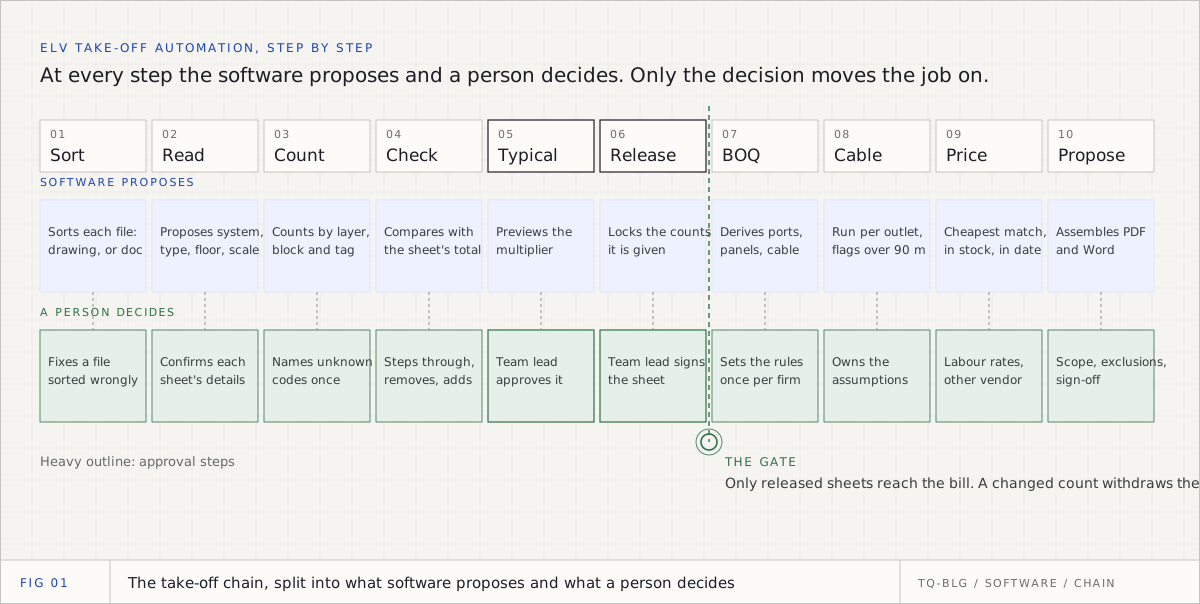
ELV take-off automation: what software can do, and what a person must still decide
Most of an ELV and security take-off can be automated: reading the drawings, counting tagged devices, deriving ports and panels, measuring cable, finding the cheapest vendor. Deciding is not. This is the chain, step by step, with a worked example of what a single unchecked miss does to the bill.
Quantity take-off software for ELV contractors in 2026: an honest comparison
The real options for an ELV estimating team in the GCC, from spreadsheets to general AI take-off tools to ELV-specific software, judged on the criteria that decide an ELV purchase. Vendor facts fetched from their own pages on 14 October 2026, with links, and TrueQty assessed with its limits.
What are ELV systems? The meaning in construction, the full list, and who approves them
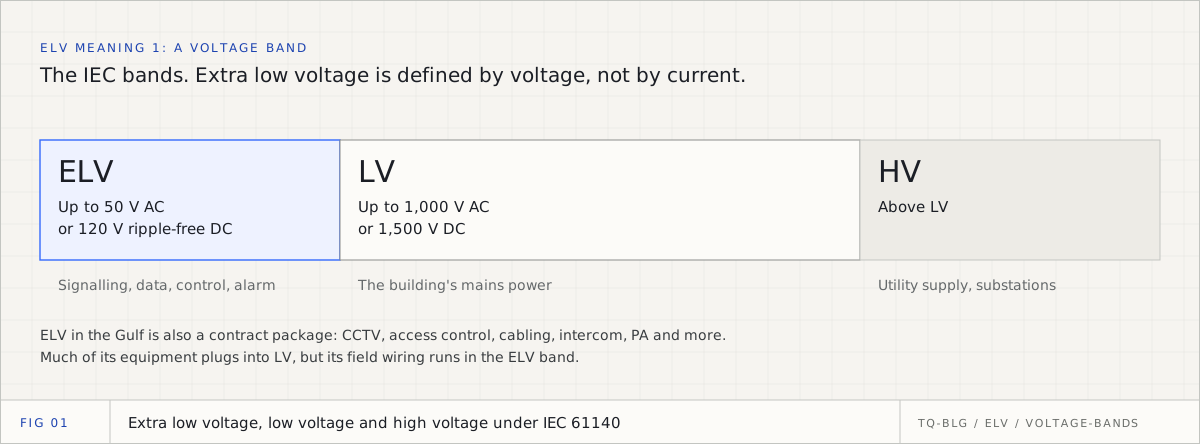
ELV means two things. To an electrical engineer it is a voltage band under 50 V AC. To a Gulf contractor it is a package of systems: CCTV, access control, cabling, intercom, PA and more. This explainer covers both, the list, and who designs, approves and prices them.