
How to build an ELV BOQ from drawings: a worked example across CCTV, access control and structured cabling
A worked example that takes one illustrative office building from drawings to a bill of quantities across three systems, with the basis of every number written next to it and a sample BOQ table you can reuse.
- Doc no
- TQ-BLG-261014-69
- Rev
- Issued
- Author
- Zakaria Syed
- Category
- BOQ and estimating
- Reading
- 9 min
To build an ELV BOQ from drawings, take off each system by the reasoning it needs, then derive what the drawings imply but do not show. Count CCTV cameras by type and size recorders, storage and PoE from the count. Count access-controlled doors by type and assemble each door's hardware. Count data points per floor and aggregate them into cable, patch panels and switch ports with spare capacity. Write the basis next to every quantity. Below, one illustrative building goes through all three systems, ending in a sample BOQ table.
This post assumes you already have a verified take-off; the ELV quantity take-off guide covers how to get one.
Take-off and BOQ are not the same document
The take-off is what the drawings say, floor by floor: 34 indoor domes, 26 controlled doors, 616 data points. The BOQ is what you will buy, install and be paid for: recorders, storage, controllers, lock power supplies, patch panels, switches, boxes of cable, containment, testing. Most of the money in an ELV bill sits in lines that are not drawn as symbols, which is why a BOQ copied straight from the take-off is always short.
The working file should keep three columns that the issued BOQ may not show: the basis (where the number came from), the assumption (anything you decided rather than read), and the source sheet.
The example building
Every number below is illustrative: a made-up building, chosen to be typical of a Dubai mid-rise office. Use the method, not the figures.
| Parameter | Value (illustrative) |
|---|---|
| Floors | Ground floor plus six typical office floors (levels 1 to 6) |
| Typical floor note | Levels 1 to 6 identical, approved as x6 |
| Main equipment room | Ground floor, which also serves the ground floor |
| Floor racks | One per typical floor, in the riser room |
| Floor-to-floor height | 4 m |
| Location | Dubai, so SIRA rules apply to CCTV and access control |
CCTV: count by type, then size what the cameras imply
The count
| Camera type | Ground | Each typical floor | Typical floors (x6) | Total |
|---|---|---|---|---|
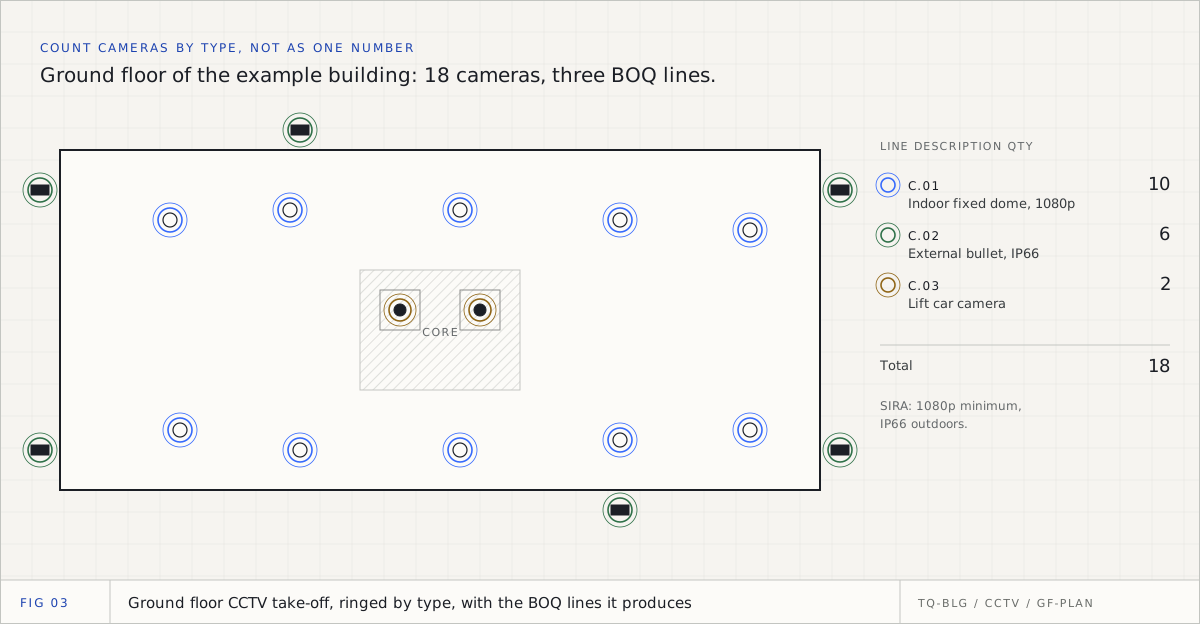
| Indoor fixed dome, 1080p | 10 | 4 | 24 | 34 |
| External bullet, IP66 | 6 | 0 | 0 | 6 |
| Lift car camera | 2 | 0 | 0 | 2 |
| Total | 18 | 4 | 24 | 42 |
Keep camera types as separate BOQ lines (the CCTV BOQ guide goes further into each of them). In Dubai the SIRA specification requires cameras of at least Full HD 1080p and outdoor cameras of at least IP66, so the external bullets cannot be priced as indoor units with a housing.
Recorders and storage
SIRA requires recording for not less than 31 days, and the recording devices to be computed with 20 percent extra capacity. With motion-based recording, the specification asks for not less than 70 percent of the day per camera. The storage formula:
storage per camera (bytes) = bitrate (bits/s) x 86,400 s x recorded fraction x days / 8
total = storage per camera x cameras x 1.20
With an assumed average of 4 Mbps per camera (state yours: it depends on resolution, codec and scene):
- 4,000,000 x 86,400 x 0.70 x 31 / 8 = about 0.94 TB per camera
- 0.94 TB x 42 cameras = 39.4 TB
- 39.4 TB x 1.20 = 47.2 TB usable, before any RAID overhead
Recorder channels follow the count with headroom: 42 cameras fit two 32-channel recorders with 22 channels spare, or one 64-channel unit. SIRA also requires the system to run on UPS for at least 30 minutes, so the UPS line belongs in the CCTV section, sized on the recorders, switches and cameras it carries.
PoE switching and power budget
Every IP camera takes a switch port and draws power from it. Size the power budget on each camera's maximum draw, not its typical one: Axis notes that maximum power reflects worst-case conditions, which for an external bullet means the IR illuminator and heater running at night in winter.
| Camera | PoE class (assumed) | Power at the switch | Cameras | Budget |
|---|---|---|---|---|
| Indoor dome | Class 3 (802.3af) | 15.4 W | 34 | 523.6 W |
| Lift camera | Class 3 | 15.4 W | 2 | 30.8 W |
| External bullet with IR and heater | Class 4 (802.3at) | 30 W | 6 | 180 W |
| Total | 42 | 734.4 W |
The power figures are the PSE values from the IEEE classes (802.3af delivers 15.4 W at the switch and 12.95 W at the device; 802.3at delivers 30 W and 25.5 W). Ports are counted per rack: 18 on the ground floor rack, 4 on each typical floor.
Cable
Every camera is one horizontal run, limited to a 90 m permanent link. Using the method in the ELV cable calculation guide, assume an average of 38 m per CCTV run including slack. A 305 m box holds 8 whole runs of 38 m, so 42 runs need 6 boxes (1,830 m). Dividing total length by 305 would say 5.2 boxes and leave you short, because a run cannot be spliced across two boxes.
Access control: assemble the door, never count the reader
The door-type schedule
| Door type | Hardware per door | Ground | Each typical floor | Total doors |
|---|---|---|---|---|
| A: single leaf, card | Card reader, EM lock, door contact, push button, break glass | 10 | 2 | 22 |
| B: single leaf, face | Face reader, EM lock, door contact, push button, break glass | 3 | 0 | 3 |
| C: double leaf entrance | Card reader, 2 EM locks, 2 door contacts, push button, break glass | 1 | 0 | 1 |
| Total | 14 | 2 | 26 |
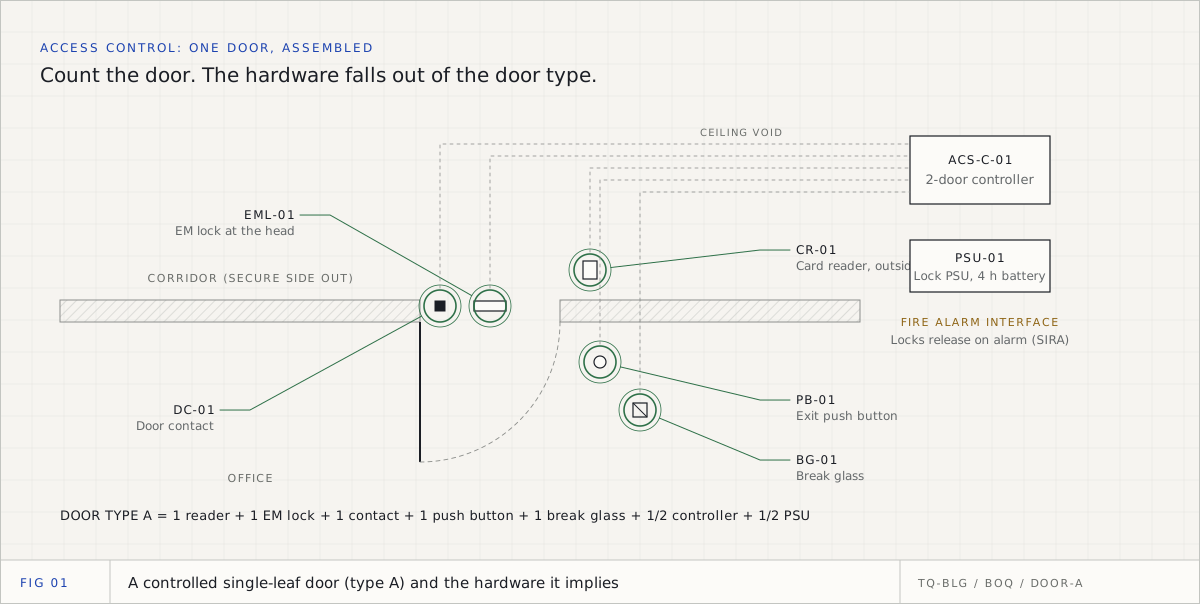
The hardware that falls out of it
| Item | Basis | Qty |
|---|---|---|
| Card reader | 22 type A + 1 type C | 23 |
| Face recognition reader | 3 type B | 3 |
| Electromagnetic lock | 22 + 3 + (1 x 2) | 27 |
| Door contact | 22 + 3 + (1 x 2) | 27 |
| Exit push button | 26 doors | 26 |
| Break glass unit | 26 doors | 26 |
| Two-door controller | Per floor: ground 14 doors = 7, each typical floor 2 doors = 1 | 13 |
| Lock power supply with battery | One per controller (assumed) | 13 |
Two things change this table in practice. First, the controller model: a controller with its own door inputs (door contact, exit button, PSU fail, tamper) and two reader ports, as most do, is counted per pair of doors, not per door. Second, the rules: SIRA requires locks that release automatically in an emergency, integration with the Civil Defence approved fire alarm, and a control panel battery of at least four hours. That puts a fire alarm interface on every controller and sizes the battery line.
Counting doors this way is also how TrueQty reads access control from a drawing: it infers each controlled door from the cluster of hardware drawn around it (reader, contact, lock, button, break glass) and counts the hardware directly, rather than guessing hardware from a door type. On one contractor's real ground-floor BOQ that gave exact matches on door contacts, locks, push buttons and face readers.
Structured cabling: aggregate from the outlet up
The count
| Floor | Data points (incl. wireless access points) |
|---|---|
| Ground | 40 |
| Each typical floor | 96 |
| Typical floors (x6) | 576 |
| Total | 616 |
Count points, not faceplates: a double outlet is two points, two cables and two panel ports.
Panels and switches, per rack
| Rack | Points | Patch panels (24-port) | Ports with 20% spare | Switches (48-port) |
|---|---|---|---|---|
| Ground (MER) | 40 | 2 | 48 | 1 |
| Each typical floor | 96 | 4 | 116 | 3 |
| Typical floors (x6) | 576 | 24 | 696 | 18 |
| Total | 616 | 26 | 744 | 19 |
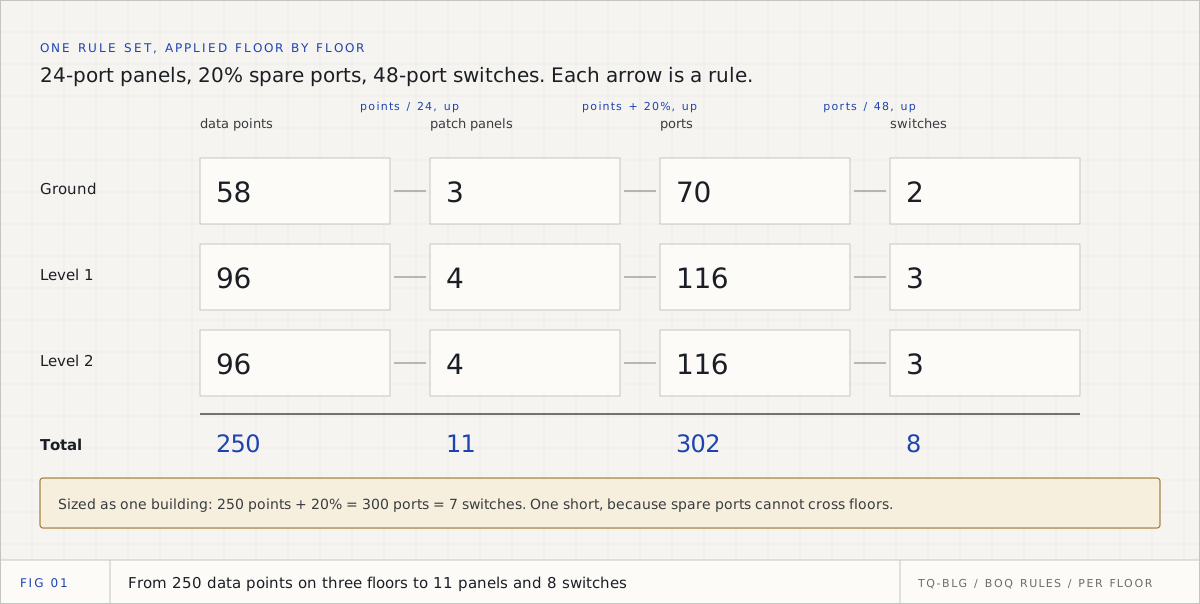
Calculate per rack, never per building: a spare port on level 2 cannot serve level 5. Note that CCTV cameras and access controllers also need switch ports; whether they share the data switches or get their own PoE switches is a design decision, so record it as an assumption and add the ports to the right rack. TrueQty's BOQ rules use exactly these defaults (24-port patch panels, 48-port switches with 20 percent spare ports), and every one is editable per company, because they are assumptions and should look like assumptions.
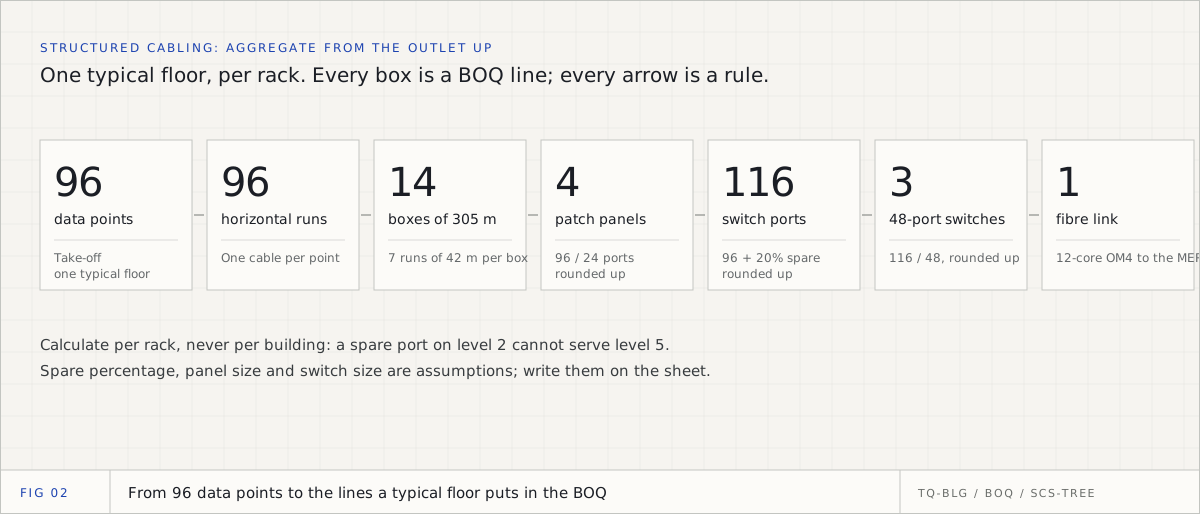
Horizontal cable
Assume an average run of 42 m on the typical floors and 35 m on the ground floor, slack included. A 305 m box holds 7 runs of 42 m, so a typical floor's 96 runs need 14 boxes, and six floors need 84. The ground floor's 40 runs at 35 m fit 8 to a box, so 5 boxes. Total: 89 boxes (27,145 m).
Backbone
Each typical floor rack links to the main equipment room over fibre. With a 12-core OM4 link per floor and an illustrative length of 20 m horizontal, plus 4 m per floor of riser, plus 5 m of slack at each end, the six links are 34, 38, 42, 46, 50 and 54 m: 264 m of 12-core fibre and 12 terminations (both ends of six links).
The sample BOQ
The issued BOQ carries the description, unit and quantity. Keep the basis column in your working file even if the client's format drops it. The same layout, with the counts by floor and the switch and cable box rules as formulas, is in the free ELV BOQ template for Excel.
| Item | Description | Unit | Qty | Basis |
|---|---|---|---|---|
| CCTV | ||||
| C.01 | Indoor fixed dome camera, 1080p minimum, PoE | No. | 34 | Take-off, all floors |
| C.02 | External bullet camera, 1080p minimum, IP66, IR | No. | 6 | Take-off, ground |
| C.03 | Lift car camera, 1080p minimum | No. | 2 | Take-off, ground |
| C.04 | Network video recorder, 32 channel | No. | 2 | 42 cameras plus spare channels |
| C.05 | Recorder storage, usable | TB | 47.2 | 4 Mbps, 70%, 31 days, +20% (SIRA) |
| C.06 | Cat6 U/UTP cable, solid, LSZH | Box 305 m | 6 | 42 runs, 8 per box |
| C.07 | UPS for CCTV, minimum 30 minutes | No. | 1 | SIRA |
| Access control | ||||
| A.01 | Proximity card reader | No. | 23 | Door types A and C |
| A.02 | Face recognition reader | No. | 3 | Door type B |
| A.03 | Electromagnetic lock, with bracket | No. | 27 | Door schedule |
| A.04 | Door contact | No. | 27 | Door schedule |
| A.05 | Exit push button | No. | 26 | One per door |
| A.06 | Break glass unit | No. | 26 | One per door |
| A.07 | Two-door controller with fire alarm interface | No. | 13 | Per floor, two doors each |
| A.08 | Lock power supply with 4 h battery | No. | 13 | One per controller, SIRA |
| Structured cabling | ||||
| S.01 | Cat6 data point, complete, tested | No. | 616 | Take-off, all floors |
| S.02 | Cat6 U/UTP cable, solid, LSZH | Box 305 m | 89 | Runs per box, per floor |
| S.03 | Patch panel, 24-port, Cat6 | No. | 26 | Per rack |
| S.04 | Access switch, 48-port | No. | 19 | Per rack, 20% spare |
| S.05 | Fibre backbone, 12-core OM4 | m | 264 | Six links, riser schematic |
| S.06 | Fibre termination, 12-core, both ends | No. | 12 | Six links x 2 |
A real BOQ adds cabinets, cable management, containment, testing and certification, documentation, training and the system head-ends (video management software, access control server). They follow the same rule: write the basis.
Descriptions, units and measurement conventions
Read the preambles before you settle units. Many GCC contracts still name POMI (the RICS Principles of Measurement, International), which RICS archived in March 2023; others name NRM 2 or the client's own method. In practice for ELV: devices are numbered items, cable is linear metres or boxes, containment is linear metres, and "complete" items (a data point "complete, tested") carry their faceplate, module, patch panel port and test in one rate. Whichever you use, use it consistently; a bill that measures cable in metres on one system and boxes on another invites a rate query.
Checks before the BOQ goes to pricing
- Every counted line traces back to the take-off and the sheet.
- Every derived line has a written basis and its assumptions.
- Per-rack items (panels, switches, PoE budget) were calculated per rack.
- Cable was converted to boxes by runs per box, not total length.
- Regulatory minimums (SIRA retention and storage margin, UPS time, battery hours, IP rating) appear as lines, not as notes.
- Nothing is priced at zero. When TrueQty prices a BOQ from your suppliers' price lists, each line is matched to the cheapest eligible supplier, and any line with no match stays visible as a gap, so the total reads as incomplete until every line has a price.
For how quantities like these come out of the drawings with their evidence attached, see the systems overview, and pricing to try it on a real tender. When the drawings themselves are the problem (no legend, flattened exports, scans), start with take-off from difficult drawings.
Take off one real ELV sheet, with the evidence for every count on the drawing.
14 days, one full ELV tender, no card. Sign up with your work or personal email. You check every count, a team lead approves each sheet, and only approved sheets reach the BOQ.
Questions engineers ask
- Q01What should an ELV BOQ include?
- For each system, the counted devices by type, the items they imply that are not drawn (controllers, power supplies, recorders, storage, switch ports, patch panels), cable and containment by length, and the commissioning, testing and documentation items. Each line needs a description, a unit, a quantity and, in your working file, the basis of the quantity.
- Q02How do you calculate CCTV storage for a BOQ in Dubai?
- Storage per camera is bitrate times seconds recorded per day times retention days, divided by eight to convert bits to bytes. SIRA's specification requires recording for not less than 31 days and recorders computed with 20 percent extra capacity, so multiply the total by 1.2. State your bitrate assumption, because it depends on resolution, codec and scene activity.
- Q03How many items make up one access-controlled door?
- A standard single-leaf controlled door is usually five devices (reader, electromagnetic lock, door contact, exit push button and break glass) plus a share of a door controller and a lock power supply. Double doors, face readers, exit readers and turnstiles change the assembly, so build a door-type schedule and count doors by type.
- Q04How many patch panels and switches do I need for a given number of data points?
- Patch panels are data points divided by the panel size, rounded up per rack, for example 96 points on 24-port panels is 4 panels. Switch ports are data points plus the spare percentage, for example 96 points with 20 percent spare is 116 ports, which is three 48-port switches. Calculate per rack, never per building, because ports cannot be shared between rooms.
- Q05Should cable be measured per run or per box in a BOQ?
- Calculate per run, then convert to boxes by how many whole runs fit in one box, because a run cannot be spliced across two boxes. Report the BOQ in the unit the specification asks for, usually linear metres or boxes of 305 m, and keep the run arithmetic in the working file.
Sources
Every external fact in this document is cited to one of these, fetched when it was written.
- [01]SIRA, Standard and Technical Specifications of the Security Systems, Version 4.0 (2022)sira.gov.ae
- [02]Axis, Typical and maximum power consumption in Axis cameraswhitepapers.axis.com
- [03]Ethernet Alliance, Introducing IEEE P802.3bt Power over Ethernet (class table)ethernetalliance.org
- [04]Cisco, UPOE+ white paper (802.3af and 802.3at power at the device)cisco.com
- [05]Fluke Networks, Channel, Permanent Link, Patch Cords, MPTL, E2Eflukenetworks.com
- [06]Paxton Net2 plus control unit manual (door inputs and lock wiring)manualsdir.com
- [07]Security Wholesalers, Magnetic lock with break glass and exit button wiring guidesecuritywholesalers.com.au
- [08]RICS isurv, Principles of Measurement (International) for Works of Constructionisurv.com

Zakaria is a mechanical engineer and the co-founder and COO of AI Agentiva in Dubai. He builds TrueQty, and writes here about how ELV quantities are counted, checked and priced, and where take-offs go wrong.
Related documents
CCTV BOQ in Dubai: how to take off cameras, recorders and storage to SIRA rules
A CCTV bill of quantities in Dubai is mostly lines that are not drawn: recorders, storage, switches, power, cable, the UPS. This is how to get each one from the camera count, and which numbers SIRA fixes for you.
ELV estimating rules: how GCC contractors standardise the BOQ assumptions behind every derived line
The rules that turn counted devices into switches, patch panels, organisers, backbone and cable decide most of an ELV bill. How contractors in the UAE, Saudi and Qatar write them once per firm, override them per project with a reason, and trace every derived line to its formula, with a worked example.
ELV estimation in the UAE: how ELV tenders are priced, from the tender pack to an AED proposal
How an ELV tender is estimated in the UAE, step by step: what is in the consultant's tender pack, how the quantities are built, how USD and EUR vendor quotes become an AED price at a stated rate, VAT, quote validity, qualifications, software cost and where your drawings are stored.