
CCTV BOQ in Dubai: how to take off cameras, recorders and storage to SIRA rules
A CCTV bill of quantities in Dubai is mostly lines that are not drawn: recorders, storage, switches, power, cable, the UPS. This is how to get each one from the camera count, and which numbers SIRA fixes for you.
- Doc no
- TQ-BLG-261014-SP
- Rev
- Issued
- Author
- Zakaria Syed
- Category
- BOQ and estimating
- Reading
- 7 min
A CCTV BOQ for a Dubai project starts with cameras counted by type, then derives everything the drawing does not show: recorder channels, storage, switch ports, the PoE budget, cable, containment and the UPS. SIRA's technical specification fixes several of those numbers for you. Cameras are at least 1080p, outdoor cameras are at least IP66, recording runs for not less than 31 days, recorders carry 20 percent extra capacity, and the system runs on UPS for at least 30 minutes. Everything else is an assumption, and the BOQ should say which.
This expands the CCTV section of the worked ELV BOQ example and uses the same illustrative building: a ground floor and six typical office floors, 42 cameras in total.
What SIRA fixes, and what each rule does to the bill
Security systems in Dubai sit under Law No. 12 of 2016, its implementing bylaw (Executive Council Resolution No. 1 of 2018), and SIRA's Standard and Technical Specifications of the Security Systems, version 4.0 of February 2022. The specification is the document an estimator needs, because it turns into BOQ lines:
| SIRA requirement | What it does to the BOQ |
|---|---|
| Cameras not less than Full HD 1080p | Sets the floor for every camera line; a lower-spec camera is non-compliant, not cheaper |
| Outdoor cameras at least IP66 | External cameras are their own line, not an indoor model in a housing |
| Recording not less than 70% of the day, at least 10 frames per second, for not less than 31 days | Drives storage |
| Recording devices computed with 20% extra capacity | Multiplies storage by 1.2 |
| Live view at least 25 frames per second per camera | Affects recorder and client sizing; worth stating in the head-end line |
| Copper cable, not less than CAT6, with copper-clad aluminium and copper-clad steel not allowed (stated in its cabling section for analogue systems) | Do not price a cheaper clad cable as an alternative |
| Cables numbered, labelled and specified at both ends | Labelling belongs in the installation rate or its own line |
| Cables hidden or in containment: plastic inside, galvanised metal outside | Containment by environment, priced separately |
| Systems on UPS for a minimum of 30 minutes | A UPS line in the CCTV section |
The bylaw adds the commercial side: surveillance devices need SIRA licensing, and approvals are decided within 30 days. Neither is a material line, but both belong in the programme and the assumptions.
Count cameras by type, and keep the types apart
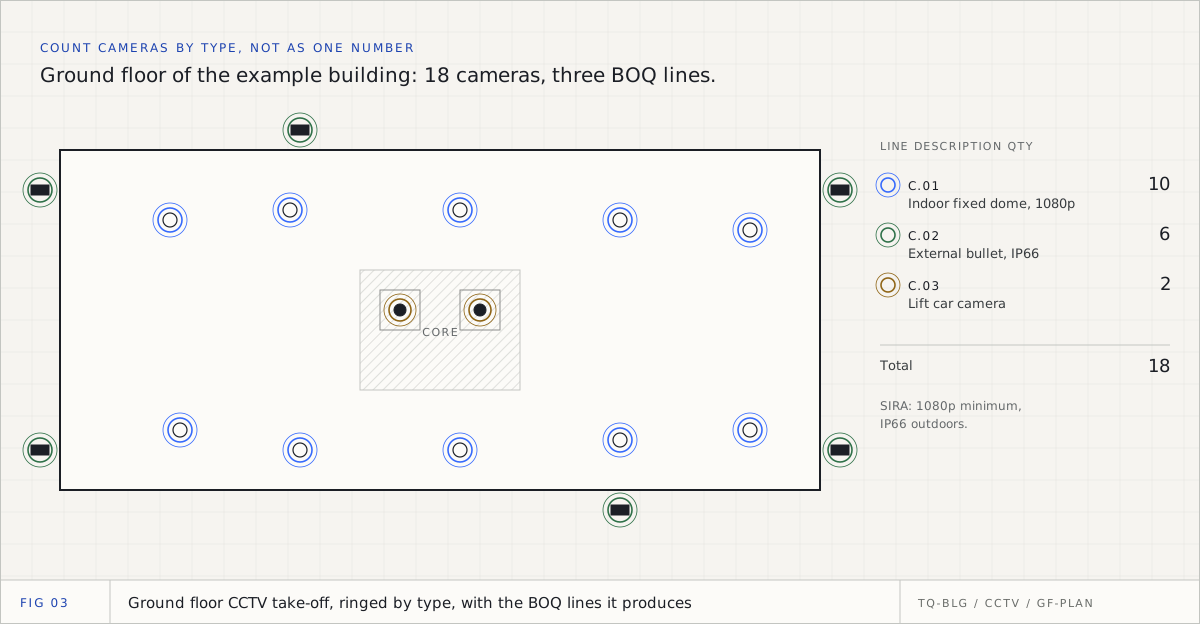
A camera schedule that says "42 cameras" cannot be priced. The ground floor of the example has three types, and each is a separate line because it has a different price, mounting and power draw:
| Line | Camera type | Ground | Typical floors (6 x 4) | Total |
|---|---|---|---|---|
| C.01 | Indoor fixed dome, 1080p minimum | 10 | 24 | 34 |
| C.02 | External bullet, IP66, IR | 6 | 0 | 6 |
| C.03 | Lift car camera | 2 | 0 | 2 |
| Total | 18 | 24 | 42 |
Watch for types the consultant distinguishes by tag rather than by symbol. A fixed dome for detection and one for identification can be drawn identically and carry different lenses. TrueQty separates about twenty camera types this way, by the CAD layer and the tag beside each symbol, and keeps the performance classes (detection, observation, recognition, identification) as separate categories, because a bill that merges them is a bill that will be re-priced.
Recorders and storage
Storage is the line most often guessed, and the easiest to show:
per camera (bytes) = bitrate (bits/s) x 86,400 x recorded fraction x days / 8
usable storage     = per camera x cameras x 1.20
With an assumed average of 4 Mbps per camera, SIRA's 70 percent of the day and 31 days:
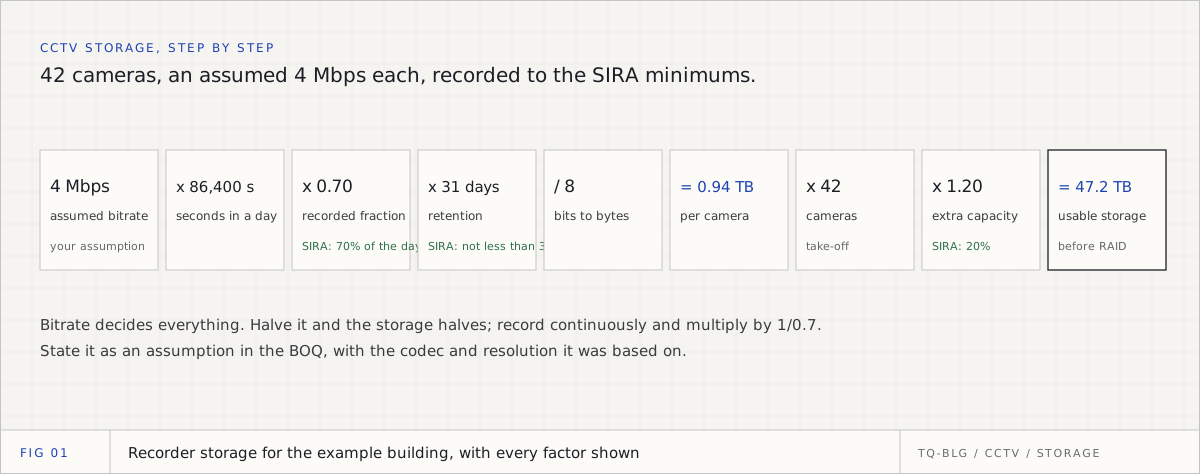
The bitrate is the assumption that matters. It depends on resolution, codec, frame rate and how busy the scene is, and nothing on the drawing tells you what it will be. Show the client what the number is sensitive to:
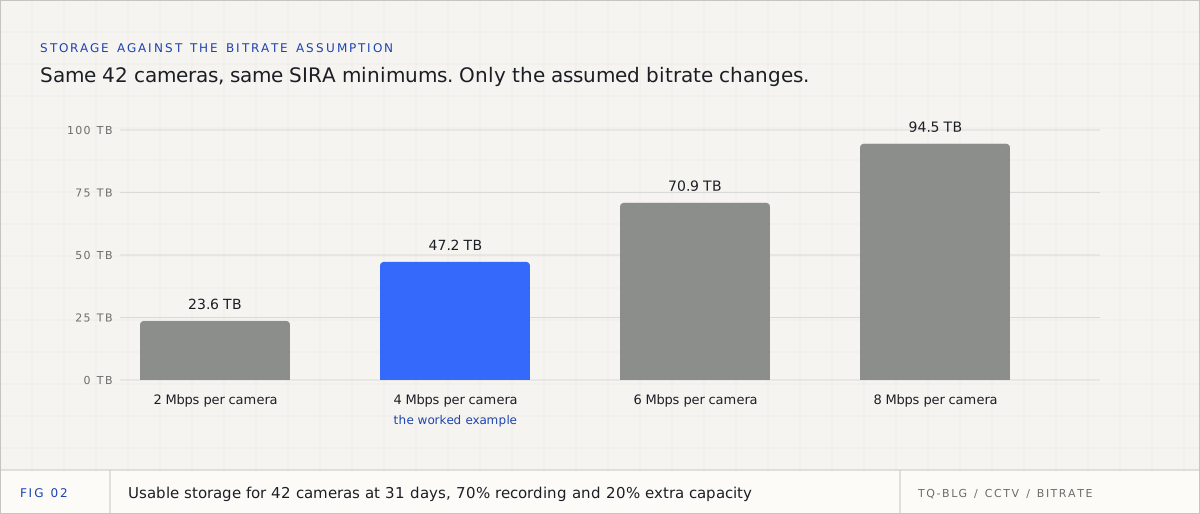
Then turn storage into recorders. 42 cameras fit two 32-channel recorders with 22 channels spare, or one 64-channel unit; choose by the specification and by how the building is split. The 47.2 TB is usable capacity. If the specification calls for RAID, add the redundancy overhead on top, and say so in the line description.
Switches and the PoE budget
Every IP camera takes a switch port and draws power from it. Count ports per rack, never per building, and size the power budget on maximum draw, not typical:
| Camera | Assumed PoE class | Power at the switch | Cameras | Budget |
|---|---|---|---|---|
| Indoor dome | Class 3 (802.3af) | 15.4 W | 34 | 523.6 W |
| Lift camera | Class 3 | 15.4 W | 2 | 30.8 W |
| External bullet, IR and heater | Class 4 (802.3at) | 30 W | 6 | 180 W |
| Total | 42 | 734.4 W |
The power figures are at the switch: 802.3af gives 15.4 W at the switch and 12.95 W at the camera, 802.3at gives 30 W and 25.5 W, and the four-pair classes of 802.3bt go up to 90 W at the switch. Axis makes the point plainly in its own guidance: maximum power is the figure that reflects worst-case conditions. For an external camera that is a winter night with the IR on and the heater running.
Ports, per rack: 18 on the ground floor rack and 4 on each typical floor. Whether the cameras share the data switches or get dedicated PoE switches is a design decision. Write it down, because it moves ports and power from one section of the bill to another.
Cable and containment
One horizontal run per camera, each limited to a 90 m permanent link within a 100 m channel. PoE does not extend that limit. The current TIA twisted-pair standard, 568.2-E, recommends Category 6A or better where power is delivered over the cable, so check whether the specification follows it before you price Cat6. With an assumed average of 38 m per run including slack, 8 whole runs fit in a 305 m box, so 42 runs need 6 boxes. The ELV cable calculation guide shows where the 38 m comes from and why boxes are counted by whole runs.
External cameras need more than cable: poles or brackets, the underground route to each pole, and galvanised containment outside, as SIRA requires. These are frequently left out of the take-off because the plan shows a camera symbol on the boundary wall and nothing else.
The head-end and the UPS
The UPS is sized on what it carries for at least 30 minutes. With illustrative assumptions:
| Load | Basis | Watts |
|---|---|---|
| Cameras through PoE | Budget above | 734.4 |
| Recorders | 2 x 150 W, assumed | 300 |
| Switch overhead | 2 x 60 W, assumed | 120 |
| Total | 1,154.4 |
At an assumed power factor of 0.8 that is about 1,443 VA, so a 2 kVA unit with batteries for at least 30 minutes at that load. Use the manufacturers' data sheets for the real figures; the point is that the UPS line has arithmetic behind it like every other line.
Add the head-end items the drawings never show: video management software and its licences per camera, client workstations and monitors, the rack or cabinet, and commissioning, testing and the SIRA approval submission.
The CCTV section, as it reaches the BOQ
| Item | Description | Unit | Qty | Basis |
|---|---|---|---|---|
| C.01 | Indoor fixed dome camera, 1080p minimum, PoE | No. | 34 | Take-off |
| C.02 | External bullet camera, 1080p minimum, IP66, IR | No. | 6 | Take-off |
| C.03 | Lift car camera, 1080p minimum | No. | 2 | Take-off |
| C.04 | Network video recorder, 32 channel | No. | 2 | 42 cameras plus spare |
| C.05 | Recorder storage, usable | TB | 47.2 | 4 Mbps, 70%, 31 days, +20% (SIRA) |
| C.06 | PoE switch capacity | W | 734.4 | Maximum draw per camera |
| C.07 | Cat6 U/UTP cable, solid, LSZH | Box 305 m | 6 | 42 runs, 8 per box |
| C.08 | Containment, galvanised, external | m | per route | External camera routes |
| C.09 | UPS, minimum 30 minutes at full load | No. | 1 | SIRA; 1,154 W assumed load |
| C.10 | Video management software, licence per camera | No. | 42 | One per camera |
| C.11 | Testing, commissioning and SIRA submission | Item | 1 |
If the project is in Saudi Arabia
The rules are different and the numbers are not the same. Saudi Arabia's Law on the Use of Security Surveillance Cameras (Royal Decree M/34 of 2022) requires covered entities to install cameras and keep recordings, but the retention periods are set in a separate Ministry of Interior requirements document rather than in the law itself. Do not carry SIRA's 31 days into a Saudi BOQ; get the project's requirement in writing and use that.
Checks before the CCTV section is priced
- Every camera line traces to counted devices on the take-off, by type and floor.
- Storage shows its bitrate assumption, recorded fraction, retention days and the 1.2 factor.
- Ports and PoE were counted per rack, on maximum power.
- No run exceeds 90 m, slack included.
- The external cameras have poles, routes and outdoor containment.
- The UPS, licences and SIRA submission are lines, not notes.
The checks only work if the camera count underneath them is verified, which is the subject of the ELV quantity take-off guide. To see how a count carries its evidence back to the sheet, look at the systems overview, or start a trial on one of your own CCTV layouts.
Take off one real ELV sheet, with the evidence for every count on the drawing.
14 days, one full ELV tender, no card. Sign up with your work or personal email. You check every count, a team lead approves each sheet, and only approved sheets reach the BOQ.
Questions engineers ask
- Q01How many days of CCTV recording does SIRA require in Dubai?
- SIRA's Standard and Technical Specifications of the Security Systems, version 4.0, requires motion-based recording of not less than 70 percent of the day per camera, at not less than 10 frames per second, for not less than 31 days. It also requires the recording devices to be computed with 20 percent extra capacity.
- Q02What is the minimum CCTV camera resolution in Dubai?
- The SIRA specification says the resolution of cameras shall not be less than Full HD 1080p, and that outdoor cameras shall be rated at least IP66. Individual project specifications often ask for more, so check both.
- Q03How do I calculate CCTV storage for a BOQ?
- Multiply the assumed bitrate in bits per second by 86,400 seconds, by the fraction of the day recorded, by the retention days, and divide by eight to get bytes per camera. Multiply by the number of cameras and by 1.2 for SIRA's extra capacity. At an assumed 4 Mbps, 42 cameras need about 47.2 TB of usable storage.
- Q04Should the PoE budget use typical or maximum camera power?
- Maximum. Axis, for example, publishes maximum power as the figure that reflects worst-case conditions, which for an outdoor camera means the IR illuminator and heater running. A switch sized on typical power will drop cameras on the first cold night.
- Q05Does the CCTV BOQ need a UPS line?
- In Dubai, yes. The SIRA specification requires the systems to run on UPS for a minimum of 30 minutes, so size it on the recorders, switches and camera power it has to carry and put it in the CCTV section, not in the electrical package.
Sources
Every external fact in this document is cited to one of these, fetched when it was written.
- [01]SIRA, Standard and Technical Specifications of the Security Systems, Version 4.0 (2022)sira.gov.ae
- [02]Dubai Law No. (12) of 2016 Regulating the Security Industry in the Emirate of Dubaidlp.dubai.gov.ae
- [03]Executive Council Resolution No. (1) of 2018, Implementing Bylaw of Law No. 12 of 2016dlp.dubai.gov.ae
- [04]Axis, Typical and maximum power consumption in Axis cameraswhitepapers.axis.com
- [05]Ethernet Alliance, Introducing IEEE P802.3bt Power over Ethernet (class table)ethernetalliance.org
- [06]Cisco, UPOE+ white paper (802.3af and 802.3at power)cisco.com
- [07]Siemon, ANSI/TIA-568.2-E Released (Annex H on power delivery)siemon.com
- [08]Fluke Networks, Channel, Permanent Link, Patch Cords, MPTL, E2Eflukenetworks.com
- [09]Saudipedia, Law of the Use of Security Surveillance Cameras in Saudi Arabiasaudipedia.com
- [10]Qanoniah, Law on the Use of Surveillance Cameras and its Executive Regulationqanoniah.com

Zakaria is a mechanical engineer and the co-founder and COO of AI Agentiva in Dubai. He builds TrueQty, and writes here about how ELV quantities are counted, checked and priced, and where take-offs go wrong.
Related documents
How to build an ELV BOQ from drawings: a worked example across CCTV, access control and structured cabling
A worked example that takes one illustrative office building from drawings to a bill of quantities across three systems, with the basis of every number written next to it and a sample BOQ table you can reuse.
ELV estimation in the UAE: how ELV tenders are priced, from the tender pack to an AED proposal
How an ELV tender is estimated in the UAE, step by step: what is in the consultant's tender pack, how the quantities are built, how USD and EUR vendor quotes become an AED price at a stated rate, VAT, quote validity, qualifications, software cost and where your drawings are stored.
ELV estimating rules: how GCC contractors standardise the BOQ assumptions behind every derived line
The rules that turn counted devices into switches, patch panels, organisers, backbone and cable decide most of an ELV bill. How contractors in the UAE, Saudi and Qatar write them once per firm, override them per project with a reason, and trace every derived line to its formula, with a worked example.