
ELV estimating rules: how GCC contractors standardise the BOQ assumptions behind every derived line
The rules that turn counted devices into switches, patch panels, organisers, backbone and cable decide most of an ELV bill. How contractors in the UAE, Saudi and Qatar write them once per firm, override them per project with a reason, and trace every derived line to its formula, with a worked example.
- Doc no
- TQ-BLG-261022-HM
- Rev
- Issued
- Author
- Zakaria Syed
- Category
- BOQ and estimating
- Reading
- 9 min
ELV estimating rules are the fixed numbers that turn counted devices into the lines the drawings do not show: ports per switch, spare ports, ports per patch panel, organisers per panel, racks, backbone length and cable allowances. To standardise them across projects, write them down once for the firm, override one only for a project whose specification says otherwise and record why, and make every derived line show the rule and the arithmetic that produced it. In the GCC the specification and the authority come first (in Dubai, SIRA requires network devices computed with 20% extra capacity), so the firm's rule is the default, never the last word.
This post is about the derived half of the bill. The counted half is covered in the ELV quantity take-off guide, and a full worked bill is in how to build an ELV BOQ from drawings.
Why the rules drift
Give one floor of 96 data points to three estimators in the same office and you can get three different bills. One allows 15% spare ports, one 20%, one 25%. One uses 24-port switches because the last job did. One measures cable at 30 m a run, another at 35 m. None of them is wrong, and none of them wrote it down. The client sees three tenders from your firm, a month apart, priced on different assumptions, and your own team cannot say which one was right.
The fix is not a better estimator. It is a short list of rules, owned by one person, applied the same way to every tender, and visible on every line it touches.
The rules that decide the derived lines
These are the rules a structured cabling and security bill depends on. The defaults in the middle column are the ones TrueQty starts every workspace with. They are common starting points, not a standard: your firm's values belong there.
| Rule | Default | What it drives | Calculated |
|---|---|---|---|
| Ports per access switch | 48 | Switch count | Per floor |
| Switch spare capacity | 20% | Ports required before rounding to switches | Per floor |
| Patch panel capacity | 24 ports | Patch panel count | Per floor |
| Cable organisers per patch panel | 1 | Organiser count | Per floor |
| Data points per floor box | 2 | Points, so ports, panels and cable | Per device |
| Default route length per run | 30 m | Cable metres, where no route is measured | Per floor, overridable |
| Cable slack | 10% | Cable metres, for terminations and service loops | Per run |
| Maximum horizontal run | 90 m | A warning on any run over it, never a quiet price | Per run |
| Racks per project | 1 | Backbone links (racks minus one) | Per project |
| Fibre backbone length per link | 40 m | Backbone metres | Per project |
Two of these need a word.
The 90 m limit is a standard, not a preference. The permanent link, from patch panel to outlet, has a maximum of 90 m; the 100 m figure people quote is the whole channel, patch cords included. A run over 90 m is a design problem to raise, not a quantity to price.
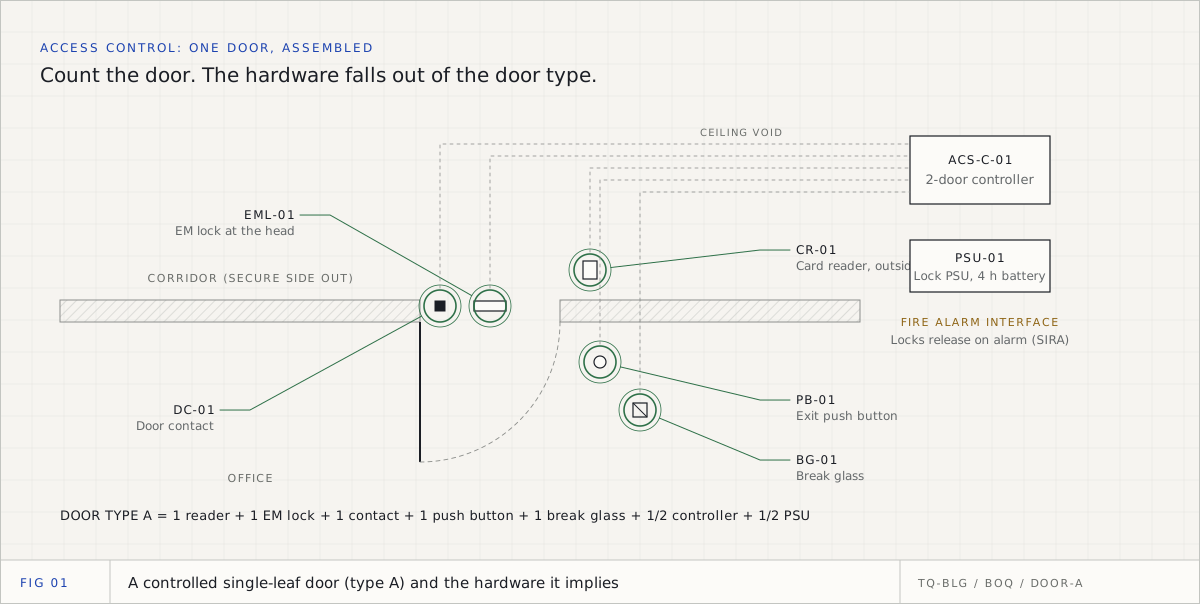
What counts as a data point is itself a rule. One data point is one switch port. An IP camera, an access control door controller and an IP intercom each take a port. A door contact, an electromagnetic lock, an exit button, a break glass unit and most card readers do not: they wire to the door controller, and the controller takes the port. Count the field devices as ports and a floor looks oversubscribed by dozens of ports that will never exist.
Where the rules come from in the GCC
A firm rule is a default for when the documents say nothing. In the UAE, Saudi Arabia and Qatar, the documents often say something, and they outrank you.
- The authority. In Dubai, SIRA's specification for security systems requires network devices to be computed with 20% extra capacity, an independent private network dedicated to security systems, and a secondary backup line on the backbone. Each of those changes a derived line: the spare percentage, whether cameras share the data switches, and how many backbone links you price.
- The consultant's specification. Spare capacity clauses, a named switch size, panel types, cable category. Saudi and Qatari projects are usually governed by the consultant's specification and the client's standards, so read the spare and sizing clauses before you apply any default.
- The client's standards. Large developers and operators often have their own ICT standards. In the UAE, TDRA's Building Telecommunications Network Specification Manual sets the requirements for telecom rooms and in-building networks in new buildings.
- The firm rule. Only where all three are silent.
The order matters more than the numbers. A firm that writes "20% spare unless the specification says otherwise" has a rule. A firm that writes "20% spare" has a habit.
Worked example: one rule set, three floors
Every number here is illustrative: a small office building with a ground floor and two typical floors, each with its own floor rack, three racks in all. The rules are the defaults in the table above.
The points per floor
| Floor | Data outlets | Floor boxes (x2 points) | Cameras | Door controllers | Video intercoms | Data points |
|---|---|---|---|---|---|---|
| Ground | 30 | 2 (4) | 18 | 4 | 2 | 58 |
| Level 1 | 80 | 2 (4) | 10 | 2 | 0 | 96 |
| Level 2 | 80 | 2 (4) | 10 | 2 | 0 | 96 |
| Total | 250 |
The ground floor also has 14 door contacts, 14 locks, 12 card readers and 14 exit buttons. They add nothing to the points: their four controllers do.
What the rules derive
| Floor | Patch panels (points / 24) | Organisers (1 per panel) | Ports (points + 20%) | Switches (ports / 48) | Cable (points x 30 m + 10%) |
|---|---|---|---|---|---|
| Ground | 3 | 3 | 70 | 2 | 1,914 m |
| Level 1 | 4 | 4 | 116 | 3 | 3,168 m |
| Level 2 | 4 | 4 | 116 | 3 | 3,168 m |
| Total | 11 | 11 | 302 | 8 | 8,250 m |
Three racks give two backbone links, at 40 m each: 80 m of fibre backbone.
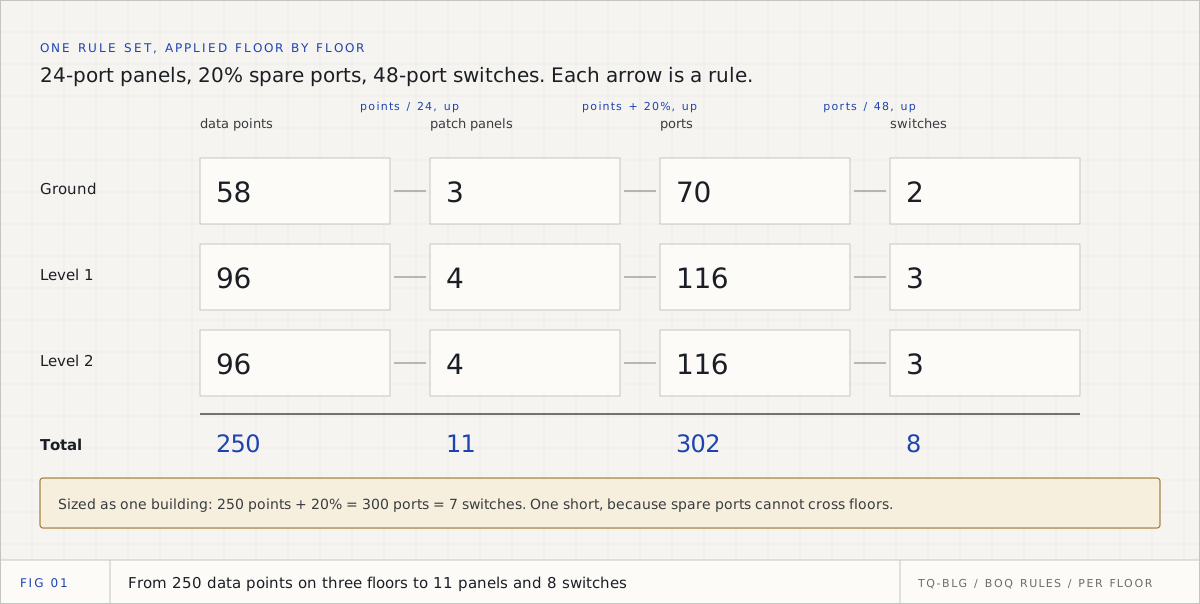
Every figure rounds up at the last step and not before: 58 points plus 20% is 69.6, which is 70 ports, which is 2 switches of 48. Rounding the switch count instead of the ports would make the spare an accident of rounding rather than capacity you meant.
Per floor, not per building
Size the same 250 points as one building and you get 250 plus 20%, 300 ports, 7 switches. That is one switch short, because the ground floor's spare ports cannot serve level 2. Patch panels happen to agree here (11 either way), which is exactly why the error survives review: one line looks right, so nobody checks the next.
Which rule changes move the bill
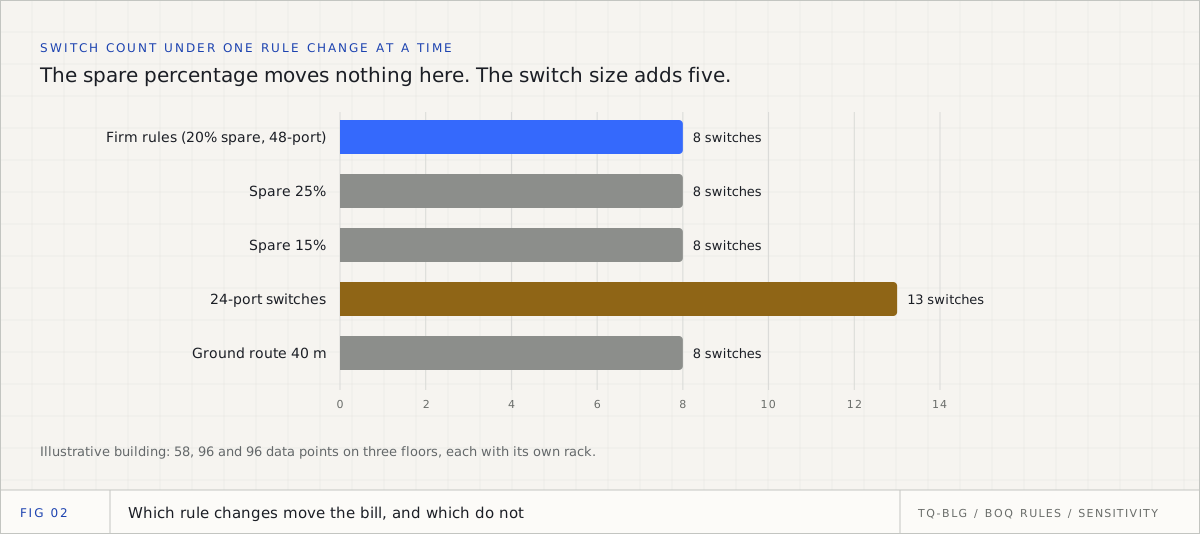
Now change one rule at a time, the way a project override would.
| Change | Switches | What moved |
|---|---|---|
| Firm rules as above | 8 | |
| Spare capacity 25% instead of 20% | 8 | Ports rise to 73, 120 and 120; no floor crosses a switch boundary |
| Spare capacity 15% instead of 20% | 8 | Ports fall to 67, 111 and 111; still no boundary crossed |
| 24-port switches instead of 48 | 13 | 3, 5 and 5 switches per floor |
| Ground floor route length 40 m instead of 30 m | 8 | Ground floor cable rises from 1,914 m to 2,552 m; total 8,888 m |
The spare percentage looked like the rule that mattered, and on this building it moves nothing. The switch size, which nobody argues about, adds five switches. That is why rules belong on the bill: a reviewer cannot judge a sensitivity they cannot see.
Firm rule, project rule, and the reason
A workable hierarchy has three levels:
- The default your software or template ships with.
- The firm rule, set by one owner, for every project.
- The project rule, for one job whose documents say otherwise, with the reason recorded.
Three habits keep it honest:
- One owner for the firm rules. Usually the estimation manager. A rule anyone can change is a rule nobody can rely on.
- A reason on every override. "Spec section 27 10 00, clause on spare capacity, asks for 25%" is a reason. "Felt light" is not.
- Old bills keep their rules. A bill already generated must not change because someone changed a firm rule this morning. It should say a rule has changed, and change only when someone regenerates it on purpose.
Every derived line shows its formula
The test of a standardised bill is that anyone can rebuild a line from what is printed next to it. For the example, level 1's switch line reads: 96 points, plus 20% spare, is 116 ports, at 48 ports per switch, is 3 switches. If a client's reviewer, your commercial manager or a variation claim two years later can follow that sentence, the rule did its job.
Write the rules into the qualifications as well: "Switches sized per floor at 48 ports with 20% spare capacity; patch panels at 24 ports; cable at measured route lengths where shown, otherwise 30 m plus 10% slack." It turns a dispute about quantities into a discussion about one assumption.
When measured quantities replace the rules
Rules are for the estimate you make before anything is measured. Once the consultant's riser drawing shows the racks, panels and switches per floor, and a cable schedule gives a length for every run, those measured figures should replace the rule-based estimate for that project. The cable schedule has its own assumptions (routing factor, drop height, slack at each end, waste, box length), and they deserve the same treatment: set once per project, visible on the length. The ELV cable calculation post walks through that method.
How TrueQty keeps the rules
TrueQty holds the rules per firm and shows them on every bill:
- Settings, BOQ rules. The workspace admin sets the firm's rules: route length, cable slack, switch spare capacity, ports per switch, patch panel capacity, organisers per panel, points per floor box, maximum run, racks and backbone length per link. Each says whether it is still the default. Every change is recorded in the audit log with the old and the new value. See your firm's BOQ rules.
- The rules strip. Every bill shows the rules it was built with. A bill already generated keeps its rules, and the strip says when one has changed since, until you click Regenerate.
- Project rules. A team lead or admin can change a rule for one project. The bill marks it as a project rule, and every other project keeps the firm's value. The route length can also be set per floor on the bill.
- Per floor. Patch panels, organisers, switches and cable are worked out floor by floor; only the backbone is project-wide.
- Measured quantities first. When a checked riser and the cable schedule give real quantities, the bill uses those instead of the estimating rules. The cable standard holds the eleven values behind every run length for the project. See the cable standard.
- Formulas, versions and export. Every derived line shows where it came from, a consistency check rebuilds the bill from its inputs, an issued version is frozen, and the bill exports to Excel. See the BOQ formulas, issue and export.
The counted lines underneath come only from drawings sent for pricing: every count traces to a spot on the drawing, and a person approves it. The how it works page shows where the rules sit in the chain.
A checklist for standardising your rules
- List every derived line in your last three bills, and the number behind each.
- Pick one value per rule, and write where it comes from.
- Name one owner for the firm rules.
- Write the hierarchy down: authority, specification, client standard, firm rule.
- Require a reason for every project override.
- Calculate per floor or per rack, never per building.
- Put the rules in the qualifications of every tender.
- Review the rules after every lost tender where the derived lines were the difference.
Rules are not glamorous, and they decide more of an ELV bill than most counts do. Write them once, keep them where every estimator and every reviewer can see them, and the next tender is priced the way the last one was, on purpose.
Take off one real ELV sheet, with the evidence for every count on the drawing.
14 days, one full ELV tender, no card. Sign up with your work or personal email. You check every count, a team lead approves each sheet, and only approved sheets reach the BOQ.
Questions engineers ask
- Q01What are ELV estimating rules?
- They are the fixed numbers an estimator uses to turn counted devices into the items the drawings do not show: ports per switch, spare port percentage, ports per patch panel, cable organisers per panel, racks, backbone length per link, average route length and cable slack. Writing them down once per firm means two estimators pricing the same floor get the same switches and the same cable.
- Q02How much spare capacity should an ELV BOQ allow on switches?
- Use what the specification asks for, and a firm default where it says nothing. In Dubai, SIRA's security systems specification requires network devices to be computed with 20% extra capacity, which is why 20% is a common default. Apply the spare to ports first, then round up to whole switches, and calculate it per floor, because a spare port on one floor cannot serve another.
- Q03Should switches and patch panels be calculated per floor or per building?
- Per floor, or more exactly per rack. Each floor's devices home to their own rack, so ports cannot be shared between floors. In the worked example in this post, 250 points sized for the whole building give 7 switches, while the same points sized floor by floor give 8, which is the number actually needed.
- Q04When should a project override the firm's BOQ rules?
- When the specification, the consultant or the client states a different value, such as a different switch size, a higher spare percentage or a measured route length. Record the reason with the override, keep it to that project, and leave the firm's rule unchanged for every other job.
- Q05Do estimating rules replace a measured riser and cable schedule?
- No. Rules are for when you do not have measured quantities yet. Once the riser gives racks, panels and switches, and the cable schedule gives a length per run, those measured figures should replace the rule-based estimate for that project.
Sources
Every external fact in this document is cited to one of these, fetched when it was written.
- [01]SIRA, Standard and Technical Specifications of the Security Systems, Version 4.0 (2022)sira.gov.ae
- [02]Fluke Networks, Channel, Permanent Link, Patch Cords, MPTL, E2Eflukenetworks.com
- [03]TDRA, Building Telecommunications Network Specification Manual, third edition (May 2024)tdra.gov.ae
- [04]RICS isurv, Principles of Measurement (International) for Works of Constructionisurv.com

Zakaria is a mechanical engineer and the co-founder and COO of AI Agentiva in Dubai. He builds TrueQty, and writes here about how ELV quantities are counted, checked and priced, and where take-offs go wrong.
Related documents
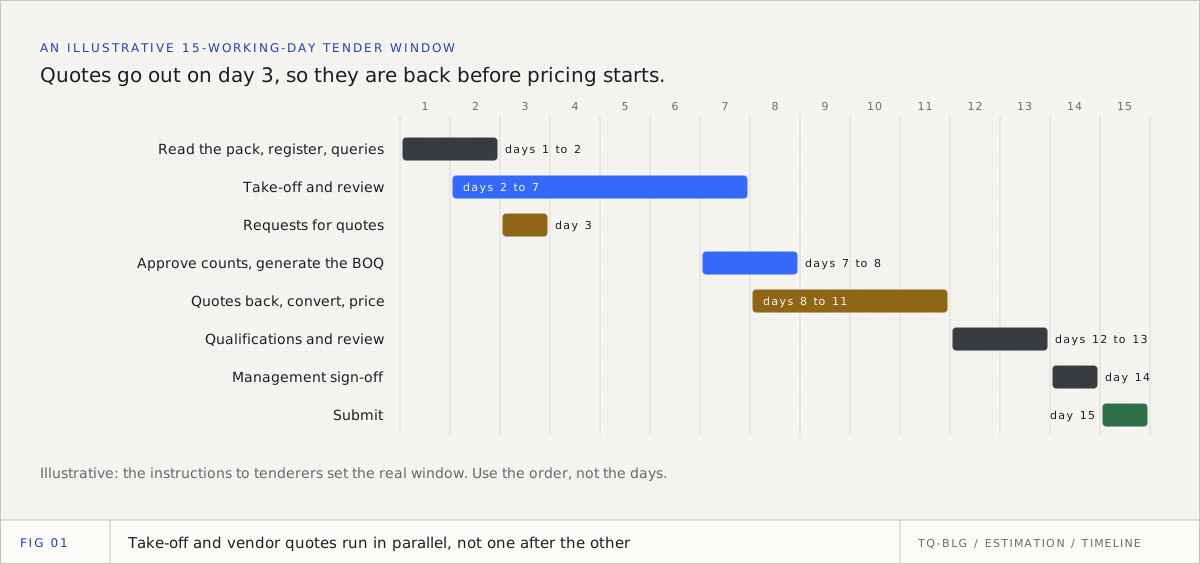
ELV estimation in the UAE: how ELV tenders are priced, from the tender pack to an AED proposal
How an ELV tender is estimated in the UAE, step by step: what is in the consultant's tender pack, how the quantities are built, how USD and EUR vendor quotes become an AED price at a stated rate, VAT, quote validity, qualifications, software cost and where your drawings are stored.
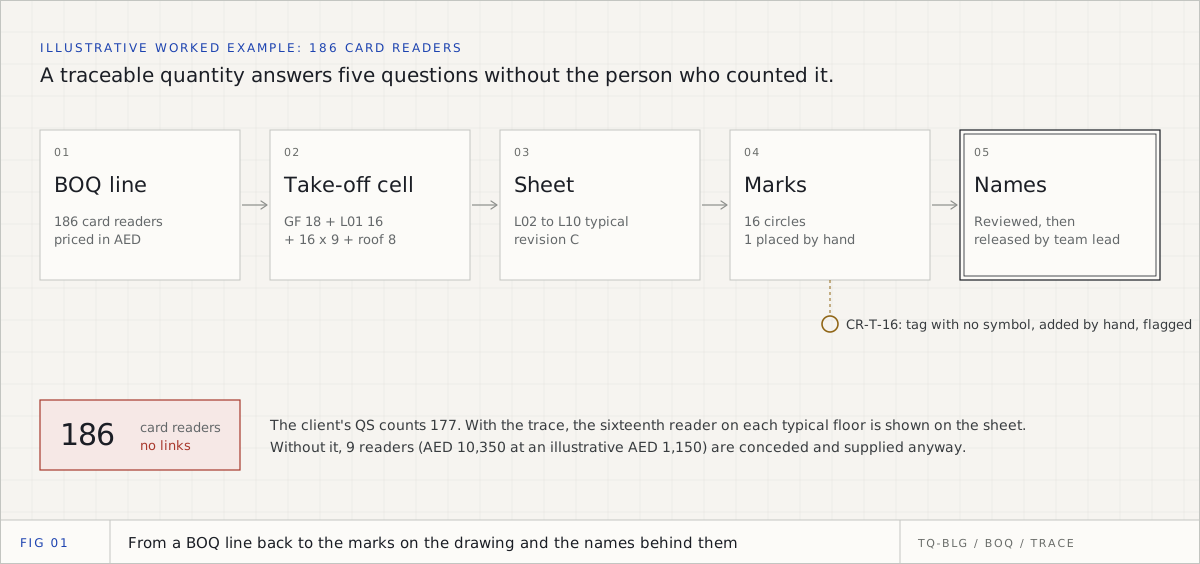
Traceable quantities in a tender BOQ: why every number needs a mark on a drawing and a name
A quantity in a tender BOQ is challenged at least once: by the consultant, by procurement, in a variation or at final account. A number that traces to marks on a drawing and a named approver settles the question in minutes. A total from a black box, however accurate it claims to be, starts an argument.
How to build an ELV BOQ from drawings: a worked example across CCTV, access control and structured cabling
A worked example that takes one illustrative office building from drawings to a bill of quantities across three systems, with the basis of every number written next to it and a sample BOQ table you can reuse.