
Traceable quantities in a tender BOQ: why every number needs a mark on a drawing and a name
A quantity in a tender BOQ is challenged at least once: by the consultant, by procurement, in a variation or at final account. A number that traces to marks on a drawing and a named approver settles the question in minutes. A total from a black box, however accurate it claims to be, starts an argument.
- Doc no
- TQ-BLG-261022-KH
- Rev
- Issued
- Author
- Zakaria Syed
- Category
- BOQ and estimating
- Reading
- 9 min
Traceable quantities are quantities in a tender BOQ that can each be followed back to the marks on a specific drawing revision and to the named person who approved them. They matter because every ELV quantity in a GCC tender is challenged at least once (by the consultant's QS at clarification, by procurement after award, in a variation, or at final account), and a number with a trace is settled in minutes while a bare total starts an argument.
This is a point of view, not a neutral survey. It follows from the verification step in the ELV quantity take-off guide, and it applies whether you count by hand, in a spreadsheet or with software.
What traceable means, link by link
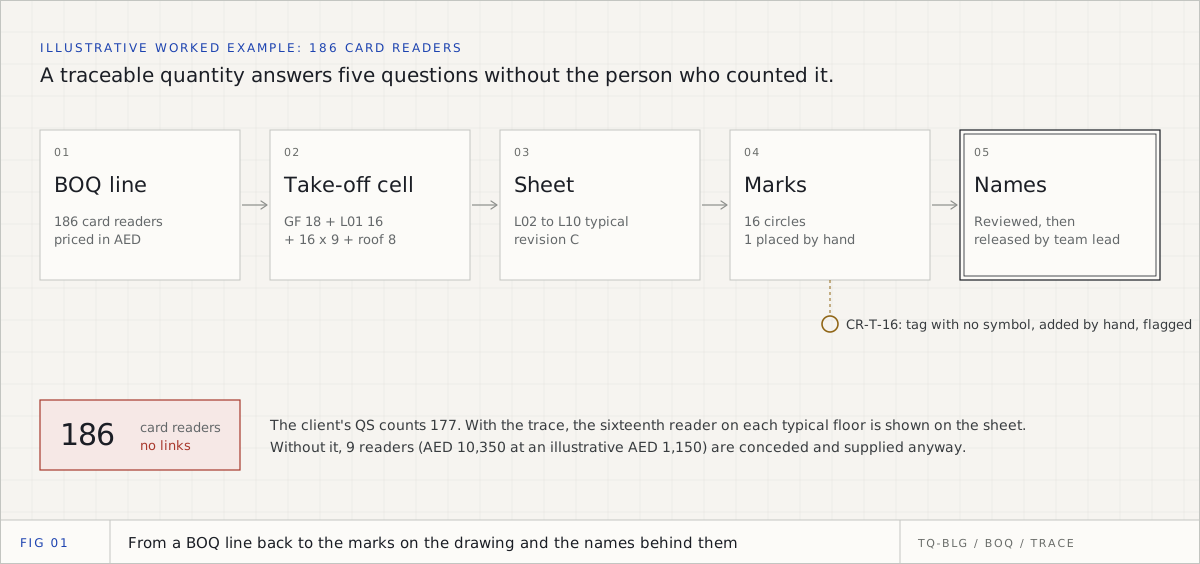
A quantity is traceable when someone who did not count it can answer five questions without asking the person who did.
| Link | Question it answers | Example |
|---|---|---|
| BOQ line | What is priced? | 186 card readers, AED rate, total |
| Take-off cell | Which floors and types make up the number? | GF 18, L01 16, L02 to L10 16 x 9, roof 8 |
| Sheet and revision | Which drawing was it counted from? | The typical floor sheet, revision C |
| Marks | Where on the sheet is each device? | 16 circles, one per reader, one placed by hand |
| Names and dates | Who reviewed it, who approved it, when? | Reviewed by the estimator, released by the team lead on a stated date |
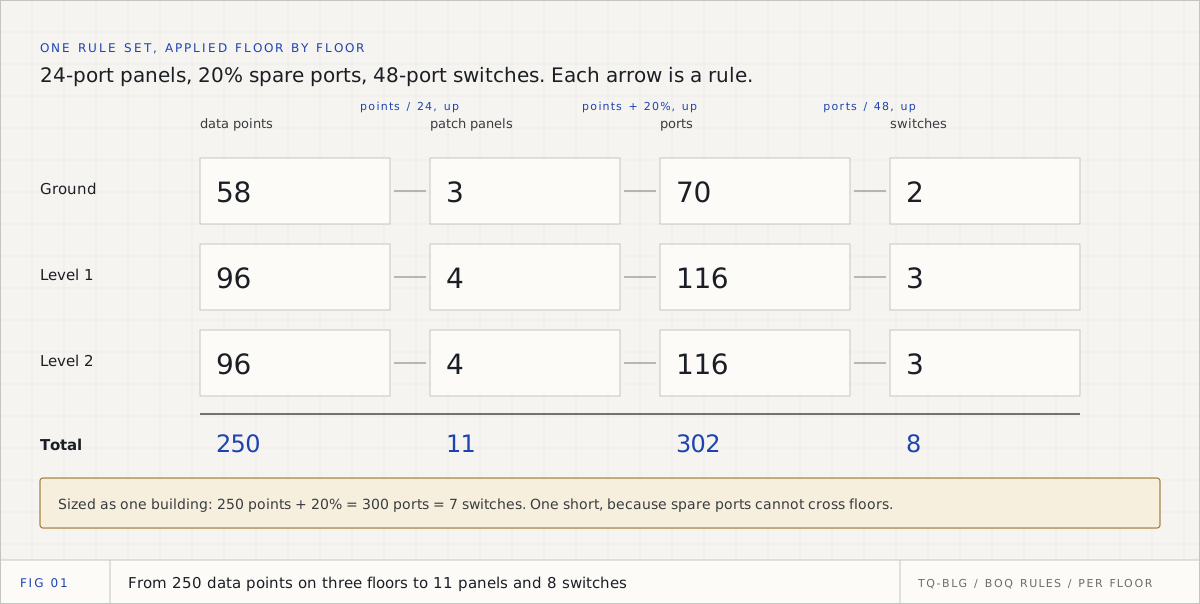
For derived lines (switches, patch panels, cable, power supplies) the third and fourth links are replaced by the formula and its inputs: "23 cameras + 2 spare ports, 24 ports per switch, so 2 switches". A derived line is traceable when the formula and every input are shown, and each input is itself traceable.
The four moments a quantity is challenged
| Moment | Who asks | What they need |
|---|---|---|
| Tender clarification | The consultant or client QS comparing bids | Why your count differs from theirs, floor by floor |
| After award | Procurement, the site team, the supplier | What to order, per floor, for delivery |
| Variation | The engineer assessing a revised drawing | What the tender included, so the change can be measured |
| Final account, audit or dispute | The client's QS, an auditor, an adjudicator | Evidence of how the number was produced and by whom |
In each case the cheapest answer is the original evidence. The Society of Construction Law's Delay and Disruption Protocol puts the principle plainly: it "recognises that transparency of information and methodology is central to both dispute prevention and dispute resolution", and its first core principle is that the parties agree what records to keep and resource that agreement. The protocol is written for delay and disruption, not for BOQs, but the logic carries over: the party with contemporaneous records argues from evidence; the other argues from memory.
An illustrative worked example: 186 card readers
The figures here are an illustrative worked example, not data from a real project.
A Dubai office building is tendered with 186 card readers: ground floor 18, level 1 16, levels 2 to 10 drawn as one typical sheet with 16 each (16 x 9 = 144), and the roof 8. After submission the client's QS comes back: their count is 177. They count 15 readers on each typical floor.
Without a trace. The estimator who counted has moved to another tender. The spreadsheet says 16 for the typical floor and nothing else. Someone re-counts the typical sheet and gets 15, because the sixteenth reader, on the stair door, is a tag with no symbol: it was drawn in an external reference that did not plot. The firm concedes 9 readers. At an illustrative AED 1,150 supplied and installed, that is AED 10,350 taken off the price, for readers the building still needs and the door schedule still shows. After award they are supplied anyway.
With a trace. The team lead opens the 186, sees the typical floor as 16 x 9, opens the typical sheet filtered to card readers, and sees 16 circles. One is marked as placed by hand by the reviewer, beside the tag CR-T-16, and the sheet carries a flag that the tag had no symbol. The answer to the QS is one paragraph: the reader is tagged on the drawing, the door is a controlled stair door on the door schedule, and the symbol sits in an external reference. The query closes with the count intact.
The difference is not that one firm counted better. Both counted 16. The difference is that one could show why.
Black-box totals and the question of AI takeoff accuracy
Search for AI takeoff accuracy and most of what ranks is vendor pages quoting a headline percentage. A percentage answers the wrong question for a tender. You do not need to know how often a tool is right on average; you need to know whether this number, on this drawing, is right, and who says so.
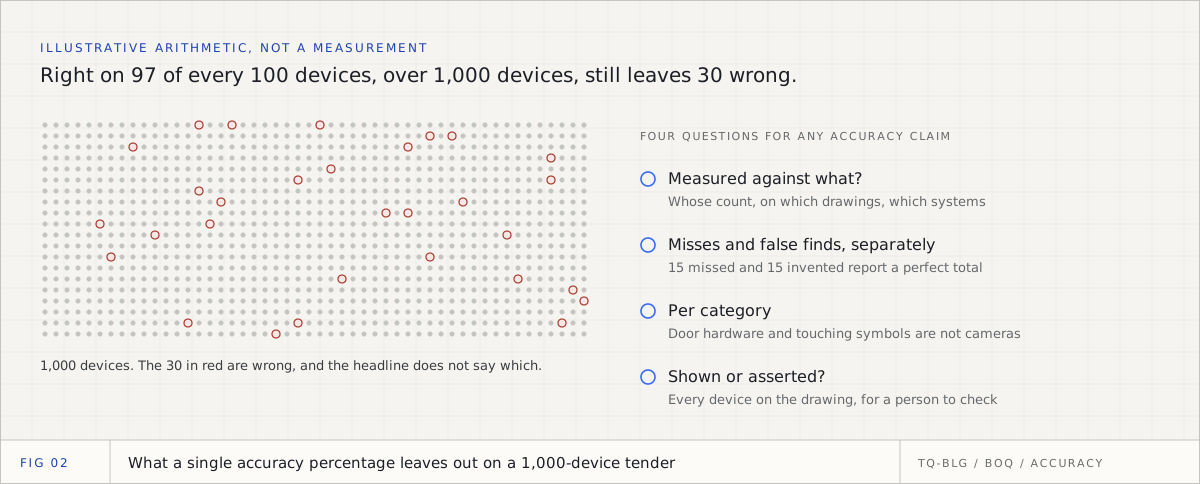
A little arithmetic shows why. As an illustration, a tool that is right on 97 of every 100 devices, run over a 1,000-device tender, leaves 30 devices wrong, and the headline does not tell you which 30, whether they are misses or false finds, or whether they cluster on the typical floor that gets multiplied. Before you rely on any accuracy claim, ask:
- Measured against what? A count by whom, on which drawings, of which systems? Clean vector sheets and scanned plots are different problems.
- Misses and false finds, separately. A tool that misses 15 and invents 15 can report a perfect total.
- Per category. Cameras on a clean sheet are easy; door hardware clusters and touching symbols are not.
- Shown or asserted? Can you see every device the tool counted, where it was drawn, and change it?
The NIST AI Risk Management Framework (AI RMF 1.0, 2023) makes the general point well. It says "a transparent system is not necessarily an accurate" system, "however, it is difficult to determine whether an opaque system possesses such characteristics", and that explainable systems "lend themselves to more thorough documentation, audit, and governance". For a take-off, transparency is not a feature beside accuracy. It is how you find out whether the count is accurate at all.
So the comparison that matters is not manual against AI. It is a reviewed take-off, where every device is shown on the drawing and a person confirms it, against a black-box total, where a number arrives and you are asked to trust it. A careful manual take-off with sheet references is closer to the first. An automated count with no marks is the second, however good its average.
Derived quantities need the same trace
Counted devices are half the bill. The rest is derived: switches from ports, patch panels from outlets, power supplies from doors, cable from runs, storage from cameras and retention. These lines are where disputes get technical, because the client's QS can agree your device count and still challenge your switches.
A derived line is defensible when:
- The formula is on the line. "35 IP cameras x 30 m x 1.10" can be checked with a calculator; "1,155 m" cannot.
- The rules are the firm's, stated once. Ports per switch, spare ports, cable allowances and routing factors are set as rules, not retyped per tender. See standardising ELV BOQ rules across GCC projects.
- The rules used are frozen with the bill. If the firm changes its spare-port policy next month, a bill already issued keeps the rules it was built with.
- The measurement method is stated. Whether cable is measured net or with allowances depends on the method of measurement the contract names, such as RICS NRM 2 or a client's own. Say which in the preambles.
Who approves, and why it is not the counter
A trace with no name at the end is half a trace. The approver is the person who says "this number goes into the tender", and it should be someone other than the person who counted. The counter knows the drawing best, and is also the person least able to see their own omissions, which is why the misses in a manual take-off survive self-checking.
Three rules make approval mean something:
- Approval is per sheet, by name and date. Not "the take-off was checked", but "this sheet was released by this person on this date".
- A change after approval withdraws it. Otherwise the approved number and the priced number can drift apart without anyone noticing.
- Only approved quantities reach the bill. If unapproved counts can be priced, approval is a formality.
If you are not using software
Traceability does not need a product. In a spreadsheet take-off, add these columns to every row and fill them in as you count, not afterwards:
- Sheet number and revision
- Floor and system
- Method: counted, from the legend, from a schedule, derived (with the formula)
- Counted by, checked by, approved by, date
- Independent check used: sheet total, tags, riser, peer floor
- Note: anything added by hand, assumed, or queried
Mark the counted devices on a copy of each PDF and keep it with the tender file. It is slower than a bare spreadsheet, and it is the only version of the take-off that answers a query from someone who was not in the room.
How TrueQty keeps every quantity traceable
TrueQty is built around one rule: every count traces to a spot on the drawing, and a person approves it.
- Every device is shown where it was drawn. You review one category at a time, each device circled on the sheet, stepping through with N, P and Enter. A tick means a person checked it, never that the computer was sure. A device added by hand is marked as placed by hand, and every change is recorded against the name of the person who made it. See review a drawing.
- Every quantity on the take-off opens its drawings. Click a number and it lists the drawings it was counted from and how many devices a reviewer added, and opens each sheet with that category already shown.
- Sending for pricing is a named approval. A team lead or admin sends each sheet for pricing; their name and the date are recorded, and the bill keeps the counts they sent. Only sheets sent for pricing reach the bill, and this is enforced on the server, so a junior cannot send a sheet even by going around the screen. A change to a count afterwards withdraws it. See send for pricing and user roles.
- Derived lines show their formula. Cable, switches, patch panels and racks show the formula and inputs behind them, and the bill's rules are kept with it. A consistency check rebuilds the bill from the exact inputs it was made from and confirms it is identical. An issued version is frozen, and any later change makes a new version.
- An audit log records every action that changes a count, a price or a document, with who and when.
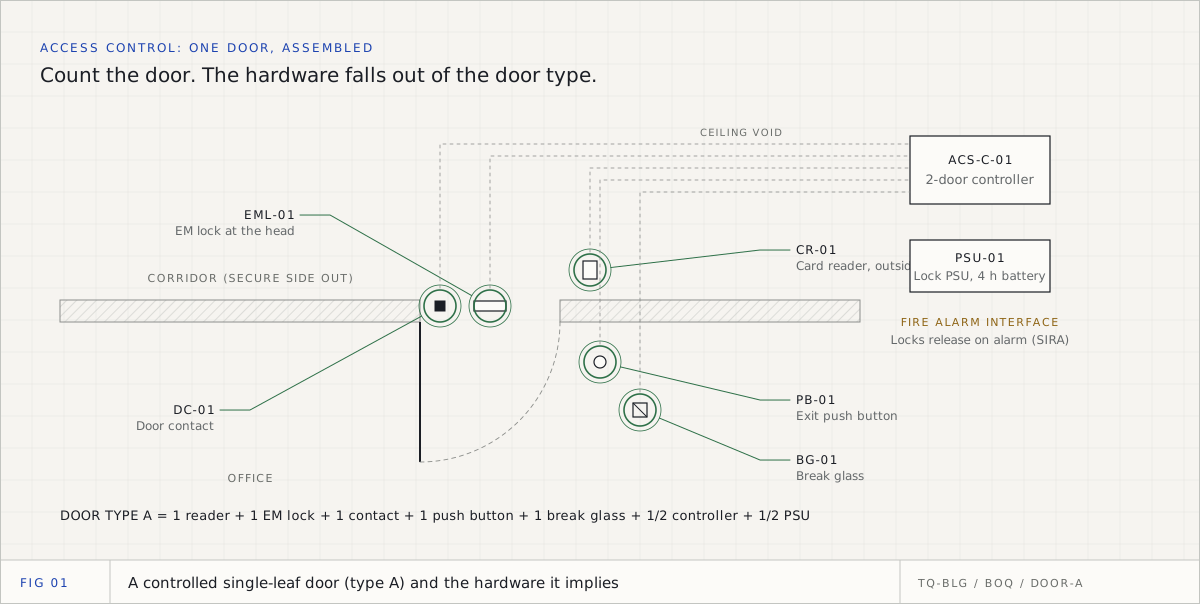
As one anonymous data point, not an accuracy claim: on a contractor's real ground-floor access control BOQ, the read matched on door contacts (15 of 15), EM locks (13 of 13), push buttons (11 of 11) and face readers (3 of 3); on the same floor it found 9 of 10 break glass units and 7 of 8 card readers, and the misses were raised as flags for a person to resolve. That is the standard worth holding any tool to: not a perfect first count, but no miss that nobody was told about. The product tour shows the chain end to end, and what can and cannot be automated in an ELV take-off explains where the person stays.
A tender BOQ is a set of claims your firm will be held to. Make each one point at its evidence, and put a name beside it, and the hardest question a client can ask (where did this number come from?) becomes the easiest to answer.
Take off one real ELV sheet, with the evidence for every count on the drawing.
14 days, one full ELV tender, no card. Sign up with your work or personal email. You check every count, a team lead approves each sheet, and only approved sheets reach the BOQ.
Questions engineers ask
- Q01What are traceable quantities in a BOQ?
- Quantities that can be followed back, line by line, to where they came from. A counted line traces to the floors and device types behind it, then to the drawing and revision, then to each mark on the sheet, and finally to the person who reviewed it and the person who approved it. A derived line, such as switches or cable, traces to its formula and the inputs it used.
- Q02What should a BOQ audit trail record?
- For every quantity: the sheet and revision it was counted from, the method (counted, read from a schedule, derived by a rule), who reviewed it, who approved it and when, and every change made after approval. For derived lines, the rule and the values it used. For the bill, which version was issued, so the number sent to the client never moves afterwards.
- Q03How accurate is AI takeoff?
- There is no independent, published benchmark for ELV take-off, so treat any single accuracy percentage with care. Ask what was counted, on which drawings, measured against whose count, and whether misses and false finds were counted separately. More useful than any percentage is whether the tool shows you each device it counted, on the drawing, so you can check the count yourself before you sign it.
- Q04Does a traceable take-off help with variations?
- Yes. A variation is priced as the difference between what was tendered and what is now required. If every tendered quantity points to a sheet, a revision and the marks on it, you can show exactly what the tender included and compare it with the revised drawing. Without that, both sides argue about the original number before they can price the change.
- Q05Who should approve a take-off before it is priced?
- A senior engineer or team lead other than the person who did the count, by name and date. The counter knows the drawing best but is also the person least likely to see their own omissions. Any change after approval should withdraw the approval, so the approved number is always the number someone signed.
Sources
Every external fact in this document is cited to one of these, fetched when it was written.
- [01]NIST, Artificial Intelligence Risk Management Framework (AI RMF 1.0), NIST AI 100-1 (January 2023)nvlpubs.nist.gov
- [02]NIST, AI Risk Management Framework overview pagenist.gov
- [03]Society of Construction Law, Delay and Disruption Protocol, 2nd edition (February 2017)scl.org.uk
- [04]RICS, New Rules of Measurement (NRM)rics.org

Zakaria is a mechanical engineer and the co-founder and COO of AI Agentiva in Dubai. He builds TrueQty, and writes here about how ELV quantities are counted, checked and priced, and where take-offs go wrong.
Related documents
ELV estimating rules: how GCC contractors standardise the BOQ assumptions behind every derived line
The rules that turn counted devices into switches, patch panels, organisers, backbone and cable decide most of an ELV bill. How contractors in the UAE, Saudi and Qatar write them once per firm, override them per project with a reason, and trace every derived line to its formula, with a worked example.
How to build an ELV BOQ from drawings: a worked example across CCTV, access control and structured cabling
A worked example that takes one illustrative office building from drawings to a bill of quantities across three systems, with the basis of every number written next to it and a sample BOQ table you can reuse.
ELV estimation in the UAE: how ELV tenders are priced, from the tender pack to an AED proposal
How an ELV tender is estimated in the UAE, step by step: what is in the consultant's tender pack, how the quantities are built, how USD and EUR vendor quotes become an AED price at a stated rate, VAT, quote validity, qualifications, software cost and where your drawings are stored.